
You are using an out of date browser. It may not display this or other websites correctly.
You should upgrade or use an alternative browser.
You should upgrade or use an alternative browser.
Windows 8 To Shut the Door on Linux?
- Thread starter Lee
- Start date
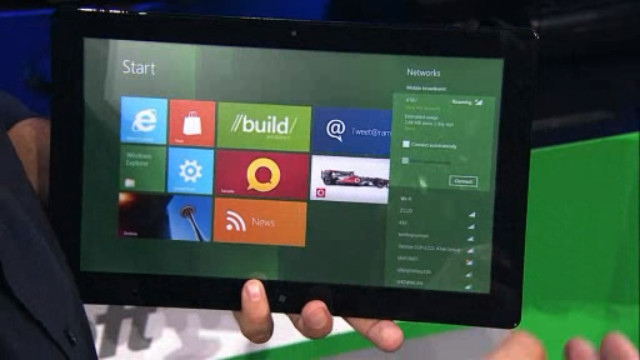
A secure boot protocol in Microsoft's new operating system threatens to prevent Linux and other unsigned software from running on Windows 8-certified machines.
It seems safe to say that a sizable proportion of Linux PC users in the world today installed the free and open source operating system on hardware that originally came loaded with Windows. After all, while there are preloaded systems available, it often ends up being cheaper to buy a Windows PC and load Linux yourself.
Once Windows 8 starts shipping on PCs, however, that may no longer be possible. It turns out that a new feature included in the operating system in the name of security may also effectively make it impossible to load Linux on officially Windows 8-certified hardware.
"It's probably not worth panicking yet," wrote Red Hat developer Matthew Garrett in a Tuesday blog post on the topic. "But it is worth being concerned."
'It Won't Be Installable'
The problem derives from Microsoft's decision to use a hardware-based secure boot protocol known as Unified Extensible Firmware Interface (UEFI) in Windows 8 rather than the traditional BIOS we're all familiar with. Microsoft principal lead program manager Arie van der Hoeven explained and demonstrated UEFI in a talk at the company's BUILD conference earlier this month.
Essentially, the technology is designed to protect against rootkits and other low-level attacks by preventing executables and drivers from being loaded unless they bear a cryptographic signature conferred by a dedicated UEFI signing key.
"There is no centralised signing authority for these UEFI keys," Garrett explained. "If a vendor key is installed on a machine, the only way to get code signed with that key is to get the vendor to perform the signing. A machine may have several keys installed, but if you are unable to get any of them to sign your binary then it won't be installable."
Microsoft has said it will require that Windows 8 logo machines ship with secure boot enabled. Most likely, Windows on such systems will be signed with a Microsoft key, Garrett predicted.
Other operating systems, such as Linux, won't include any such signatures in their current state, of course. So, unless deliberate measures are taken to make them available, "a system that ships with only OEM and Microsoft keys will not boot a generic copy of Linux," Garrett explained.
'Kernels Will Also Have to Be Signed'
Options for Linux include providing signed versions of the operating system, but there are several problems associated with that approach, Garrett pointed out.
First, a non-GPL bootloader would be required. Grub 2 and Grub are released under the GPLv3 and GPLv2, respectively, he noted.
Second, "in the near future the design of the kernel will mean that the kernel itself is part of the bootloader," Garrett added. "This means that kernels will also have to be signed. Making it impossible for users or developers to build their own kernels is not practical."
Finally, if Linux distributions sign for themselves, the required keys would have to be included by every OEM, he said.
It may turn out to be the case that Microsoft will allow vendors to provide firmware support for disabling this feature and running unsigned code, Garrett acknowledged. Even so, however, it's unlikely that all hardware will ship with that option, he added, posing problems for at least some Linux users down the road.
It remains to be seen how this situation will play out, of course. For my part, though, it sounds like one more good reason to choose hardware with Linux preinstalled.
It seems safe to say that a sizable proportion of Linux PC users in the world today installed the free and open source operating system on hardware that originally came loaded with Windows. After all, while there are preloaded systems available, it often ends up being cheaper to buy a Windows PC and load Linux yourself.
Once Windows 8 starts shipping on PCs, however, that may no longer be possible. It turns out that a new feature included in the operating system in the name of security may also effectively make it impossible to load Linux on officially Windows 8-certified hardware.
"It's probably not worth panicking yet," wrote Red Hat developer Matthew Garrett in a Tuesday blog post on the topic. "But it is worth being concerned."
'It Won't Be Installable'
The problem derives from Microsoft's decision to use a hardware-based secure boot protocol known as Unified Extensible Firmware Interface (UEFI) in Windows 8 rather than the traditional BIOS we're all familiar with. Microsoft principal lead program manager Arie van der Hoeven explained and demonstrated UEFI in a talk at the company's BUILD conference earlier this month.
Essentially, the technology is designed to protect against rootkits and other low-level attacks by preventing executables and drivers from being loaded unless they bear a cryptographic signature conferred by a dedicated UEFI signing key.
"There is no centralised signing authority for these UEFI keys," Garrett explained. "If a vendor key is installed on a machine, the only way to get code signed with that key is to get the vendor to perform the signing. A machine may have several keys installed, but if you are unable to get any of them to sign your binary then it won't be installable."
Microsoft has said it will require that Windows 8 logo machines ship with secure boot enabled. Most likely, Windows on such systems will be signed with a Microsoft key, Garrett predicted.
Other operating systems, such as Linux, won't include any such signatures in their current state, of course. So, unless deliberate measures are taken to make them available, "a system that ships with only OEM and Microsoft keys will not boot a generic copy of Linux," Garrett explained.
'Kernels Will Also Have to Be Signed'
Options for Linux include providing signed versions of the operating system, but there are several problems associated with that approach, Garrett pointed out.
First, a non-GPL bootloader would be required. Grub 2 and Grub are released under the GPLv3 and GPLv2, respectively, he noted.
Second, "in the near future the design of the kernel will mean that the kernel itself is part of the bootloader," Garrett added. "This means that kernels will also have to be signed. Making it impossible for users or developers to build their own kernels is not practical."
Finally, if Linux distributions sign for themselves, the required keys would have to be included by every OEM, he said.
It may turn out to be the case that Microsoft will allow vendors to provide firmware support for disabling this feature and running unsigned code, Garrett acknowledged. Even so, however, it's unlikely that all hardware will ship with that option, he added, posing problems for at least some Linux users down the road.
It remains to be seen how this situation will play out, of course. For my part, though, it sounds like one more good reason to choose hardware with Linux preinstalled.
Microsoft clarifies Windows 8 UEFI concerns
Microsoft's latest update to "Building Windows 8" describes the security aspects of the OS's UEFI support, of which concerns were raised recently.
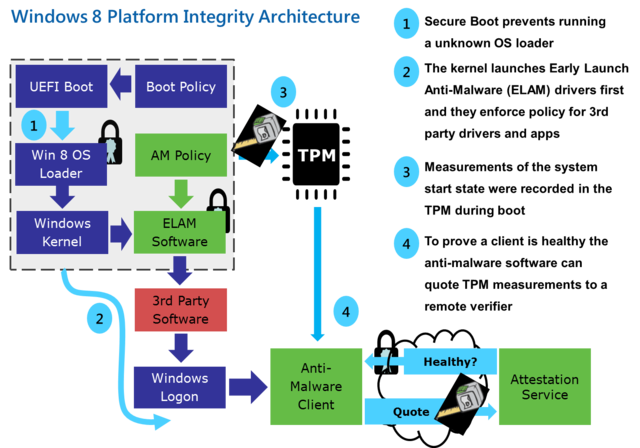
Microsoft published today the second of two Building Windows 8 blog posts detailing the operating system's new boot capabilities. Today's post focuses on the security aspects of supporting "secure boot" offered with Unified Extensible Firmware Interface (UEFI) computers.
The post comes on the heels of concerns raised yesterday by Red Hat developer Matthew Garrett, where he raised concerns about new Windows 8 machines - those that conform to the Windows 8 Logo program - may prevent alternate and/or older Windows operating systems from booting.
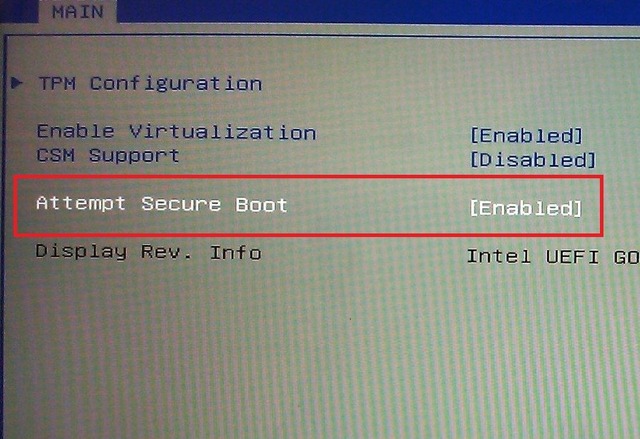
Microsoft's response, while addressing consumer concerns is fairly similar to Garrett's conclusion of how boot security will play out: security keys are signed by the OEM and are used to prevent unauthorized access to boot code. Firmware updaters supplied by OEMs contain the manufacturer's own key. In addition, while secure boot will hopefully be enabled by OEMs, it is up to the manufacturer to allow users to disable secure boot via the UEFI firmware's configuration pane, as is shown in the Samsung Windows 8 preview tablet:
Microsoft's summary of the security-related changes in Windows 8 is as follows:
Microsoft's latest update to "Building Windows 8" describes the security aspects of the OS's UEFI support, of which concerns were raised recently.
Microsoft published today the second of two Building Windows 8 blog posts detailing the operating system's new boot capabilities. Today's post focuses on the security aspects of supporting "secure boot" offered with Unified Extensible Firmware Interface (UEFI) computers.
The post comes on the heels of concerns raised yesterday by Red Hat developer Matthew Garrett, where he raised concerns about new Windows 8 machines - those that conform to the Windows 8 Logo program - may prevent alternate and/or older Windows operating systems from booting.
Microsoft's response, while addressing consumer concerns is fairly similar to Garrett's conclusion of how boot security will play out: security keys are signed by the OEM and are used to prevent unauthorized access to boot code. Firmware updaters supplied by OEMs contain the manufacturer's own key. In addition, while secure boot will hopefully be enabled by OEMs, it is up to the manufacturer to allow users to disable secure boot via the UEFI firmware's configuration pane, as is shown in the Samsung Windows 8 preview tablet:
Microsoft's summary of the security-related changes in Windows 8 is as follows:
- UEFI allows firmware to implement a security policy
- Secured boot is a UEFI protocol not a Windows 8 feature
- UEFI secured boot is part of Windows 8 secured boot architecture
- If desired, Windows 8 utilizes secured boot to ensure that the pre-OS environment is secure
- Secured boot doesn
Microsoft, Red Hat Spar Over Secure Boot-loading Tech
Is Microsoft using a next-generation computing boot-loading technology to lock out the use of Linux and other OSEs on certain computers? While Microsoft has denied malicious intent, one Red Hat developer maintains that this may be the case.
Microsoft is mandating the use of the UEFI (Unified Extensible Firmware Interface) secure boot-loading capability with Windows 8 in such a way that "the end user is no longer in control of their PC," charged Red Hat developer Matthew Garrett in a blog entry posted Friday.
Microsoft has claimed that this charge is based on a misunderstanding of the company's intentions. "At the end of the day, the customer is in control of their PC," said Microsoft program manager Tony Mangefeste in another blog posting from Microsoft.
The controversy took root on Tuesday, when Garrett pointed out in a blog posting that Microsoft-certified computers running Windows 8 may not be able to be loaded with copies of other OSes, such as Linux. Users could not install Linux as a second OS, or replace Windows with a copy of Linux, Garrett argued.
Windows 8 will require its host computer to use the UEFI, the low-level interface between the computer firmware and the OS. Marketed as a replacement to BIOS, UEFI provides a secure boot protocol, which requires the OS to furnish a digital key in order to be loaded by the machine. UEFI then can block the operations of any programs or drivers unless they have been signed by this key, a move that should prevent malware from infecting machines by changing the boot-loading process.
With Windows 8, Microsoft will require hardware manufacturers (those wishing to display the Windows logo on their units) to ship their machines with secure boot enabled. Each machine would then require a digital key from Microsoft, the hardware manufacturer or, if it uses another OS, a secure key for that OS.
Users who customize their own versions of Linux, or use a generic OS that does not come with a key, may not be able to run these OSes on machines requiring this secure booting process, Garrett said. Nor would there be any guarantee that OEMs (original equipment manufacturers) even provide the ability for users to add their own keys, or give users the option to run other OSes without a key.
Garrett's blog post subsequently sparked debate in the trade press and Linux user communities.
Responding to the controversy on Thursday, Microsoft has denied that the intent was to shut out Linux. Although he did not mention Linux by name, Steven Sinofsky, president of the Windows and Windows Live Division, noted in a blog post that some of those commenting have used details of the new plan to "synthesize scenarios that are not the case."
The rest of the posting, authored by Mangefeste, noted that Microsoft is concerned only that Windows 8 be protected in a secure boot loader, and that OEMs are free to build in the option of disabling secure boot for running OSes without keys. Other OS providers are responsible for providing their own keys.
"For the enthusiast who wants to run older operating systems, the option is there to allow you to make that decision," Mangefeste wrote. "However, [disabling secure boot] comes at your own risk," he added.
"Microsoft's rebuttal is entirely factually accurate. But it's also misleading," Garrett responded in a follow-up blog item, posted Friday. Under the licensing agreement, the equipment manufacturer is under no obligation to provide users with the ability to disable the secure boot capability. Beyond the use of third-party OSes, this approach might also hamper the ability of users to upgrade components such as graphics cards, because there is no requirement to provide the user with the capability of installing additional keys.
"The truth is that UEFI secure boot is a valuable and worthwhile feature that Microsoft are misusing to gain tighter control over the market," Garrett charged.
Is Microsoft using a next-generation computing boot-loading technology to lock out the use of Linux and other OSEs on certain computers? While Microsoft has denied malicious intent, one Red Hat developer maintains that this may be the case.
Microsoft is mandating the use of the UEFI (Unified Extensible Firmware Interface) secure boot-loading capability with Windows 8 in such a way that "the end user is no longer in control of their PC," charged Red Hat developer Matthew Garrett in a blog entry posted Friday.
Microsoft has claimed that this charge is based on a misunderstanding of the company's intentions. "At the end of the day, the customer is in control of their PC," said Microsoft program manager Tony Mangefeste in another blog posting from Microsoft.
The controversy took root on Tuesday, when Garrett pointed out in a blog posting that Microsoft-certified computers running Windows 8 may not be able to be loaded with copies of other OSes, such as Linux. Users could not install Linux as a second OS, or replace Windows with a copy of Linux, Garrett argued.
Windows 8 will require its host computer to use the UEFI, the low-level interface between the computer firmware and the OS. Marketed as a replacement to BIOS, UEFI provides a secure boot protocol, which requires the OS to furnish a digital key in order to be loaded by the machine. UEFI then can block the operations of any programs or drivers unless they have been signed by this key, a move that should prevent malware from infecting machines by changing the boot-loading process.
With Windows 8, Microsoft will require hardware manufacturers (those wishing to display the Windows logo on their units) to ship their machines with secure boot enabled. Each machine would then require a digital key from Microsoft, the hardware manufacturer or, if it uses another OS, a secure key for that OS.
Users who customize their own versions of Linux, or use a generic OS that does not come with a key, may not be able to run these OSes on machines requiring this secure booting process, Garrett said. Nor would there be any guarantee that OEMs (original equipment manufacturers) even provide the ability for users to add their own keys, or give users the option to run other OSes without a key.
Garrett's blog post subsequently sparked debate in the trade press and Linux user communities.
Responding to the controversy on Thursday, Microsoft has denied that the intent was to shut out Linux. Although he did not mention Linux by name, Steven Sinofsky, president of the Windows and Windows Live Division, noted in a blog post that some of those commenting have used details of the new plan to "synthesize scenarios that are not the case."
The rest of the posting, authored by Mangefeste, noted that Microsoft is concerned only that Windows 8 be protected in a secure boot loader, and that OEMs are free to build in the option of disabling secure boot for running OSes without keys. Other OS providers are responsible for providing their own keys.
"For the enthusiast who wants to run older operating systems, the option is there to allow you to make that decision," Mangefeste wrote. "However, [disabling secure boot] comes at your own risk," he added.
"Microsoft's rebuttal is entirely factually accurate. But it's also misleading," Garrett responded in a follow-up blog item, posted Friday. Under the licensing agreement, the equipment manufacturer is under no obligation to provide users with the ability to disable the secure boot capability. Beyond the use of third-party OSes, this approach might also hamper the ability of users to upgrade components such as graphics cards, because there is no requirement to provide the user with the capability of installing additional keys.
"The truth is that UEFI secure boot is a valuable and worthwhile feature that Microsoft are misusing to gain tighter control over the market," Garrett charged.