With the current version of TNAP, I was wondering whether there is any disadvantage to running the NON-T2MI driver if I don't have access to any T2MI signals. I switched to the T2MI driver a long time ago because I believed that the NON-T2MI driver was missing transponders on blind scan. However, at some point last year or so, a problem developed whereas the Mio would sometimes stop receiving signals after a blind scan, AND would also not receive signals after coming back from a soft-off state. Switching back to the NON-T2MI driver completely eliminated both these problems. So I'm wondering two things: first, are there still any problems finding transponders in the NON-T2MI driver; and second, has the problem with the T2MI driver not receiving signals been fixed yet.

- Home
- Forums
- FTA Set Top Box Discussions/Files
- FTA Set Top Box Discussions
- The North American Project E2 Image Discussions
You are using an out of date browser. It may not display this or other websites correctly.
You should upgrade or use an alternative browser.
You should upgrade or use an alternative browser.
T2MI vs NON-T2MI drivers
- Thread starter MrJames
- Start date

Megatron817
Administrator
Don't think there has been any T2mi driver fixes. I have got the same tuner problem when using the T2mi driver so I also use the NO-T2mi driver myself.
Don't think there has been any T2mi driver fixes. I have got the same tuner problem when using the T2mi driver so I also use the NO-T2mi driver myself.
I saw someone mention the tuner problem on the OpenPli (I think) forum when I was doing a search for it, and someone mentioned that an entirely new driver had been released, but then discussion wandered off into which version of the driver ought to be in which release of E2 and I never did see any clarification of whether the tuner problem was fixed.
The problem with the tuner not coming out of standby can be solved by leaving the box on, but the problem of not tuning after a scan is much more troublesome.

el bandido
TNAP-Images
TNAP images have a choice of three (3) T2MI drivers. Which one causes the problems? Also which TNAP image has these problems? Current version means nothing. Images have numbers. Build dates can be found in Menu--->Information--->About
I haven't tried it since the last time I updated, since the problem can't be reproduced on demand -- it doesn't happen with EVERY blind scan, and it doesn't happen with EVERY standby (unless I leave it in standby for a long time). The driver I was using was the regular T2MI one, not the European 700MHz version or whatever it was called. The current driver version, which I'm not sure when it was last updated, is 0211-10-3a. The build date of the image is 2024-05-29, last update 2024-07-29, Enigma version 2024-07-28(DXer)


I finally grew tired of the LONG blind scan times using the T2MI drivers. Some scans for a Ku satellite were taking over 7 minutes. Once I switched back to non-T2MI, my blind scans may take 1 1/2 minutes or so using the same dish. If a scan happens to miss a tp, then I can blind scan again and still save time.
el bandido
TNAP-Images
The Loooooong blindscan time is because the modded T2MI drivers are looking for symbol rates down to around 300. The Non-T2MI driver is looking for symbol rates to around 1000, with 833 I think is the lowest I ever recorded with Non-T2MI drivers.
el bandido
TNAP-Images
Go back a few pages in the thread below and you will see the low symbol rate capabilities of the TNAP modded T2MI driver.
https://www.satellites.co.uk/forums/threads/receivers-with-the-lowest-symbol-rate.174900/page-23
https://www.satellites.co.uk/forums/threads/receivers-with-the-lowest-symbol-rate.174900/page-23

EnoSat
Legit VIP
In America (more precisely South America) T2MI is used at 40W. And that too FTA and encrypted, similar to Europe.I don't know about the USA,
but in Europe there are some T2MI transmissions, but they are not encrypted,
which is not necessary because T2MI greatly reduces the number of people who can receive them.
https://www.lyngsat.com/SES-6.html
Code:
	<sat name="SES6-C (40.5W)" flags="2" position="-406">
		<transponder frequency="3803000" symbol_rate="30000000" polarization="2" fec_inner="4" system="1" modulation="2"/>
		<transponder frequency="3830000" symbol_rate="6666000" polarization="3" fec_inner="2" system="1" modulation="2"/>
		<transponder frequency="3834000" symbol_rate="15000000" polarization="2" fec_inner="4" system="1" modulation="2"/><!-- PowerVu -->
		<transponder frequency="3835000" symbol_rate="2082000" polarization="3" fec_inner="3" system="1" modulation="2"/>
		<transponder frequency="3847000" symbol_rate="6670000" polarization="2" fec_inner="3" system="0" modulation="1"/><!-- PowerVu -->
		<transponder frequency="3848000" symbol_rate="7500000" polarization="3" fec_inner="4" system="1" modulation="2"/><!-- PowerVu -->
		<transponder frequency="3853000" symbol_rate="2387000" polarization="3" fec_inner="3" system="1" modulation="2"/>
		<transponder frequency="3858000" symbol_rate="5714000" polarization="3" fec_inner="3" system="1" modulation="2"/>
		<transponder frequency="3860000" symbol_rate="2083000" polarization="2" fec_inner="3" system="1" modulation="2"/>
		<transponder frequency="3867000" symbol_rate="3255000" polarization="2" fec_inner="3" system="0" modulation="1"/>
		<transponder frequency="3875000" symbol_rate="8330000" polarization="2" fec_inner="3" system="1" modulation="2"/>
		<transponder frequency="3886000" symbol_rate="4189000" polarization="2" fec_inner="3" system="1" modulation="2" t2mi_plp_id="104" t2mi_pid="64"/><!-- portalbsd -->
		<transponder frequency="3891000" symbol_rate="3000000" polarization="2" fec_inner="4" system="1" modulation="2"/>
		<transponder frequency="3894000" symbol_rate="2787000" polarization="2" fec_inner="7" system="1" modulation="2"/>
		<transponder frequency="3898000" symbol_rate="3920000" polarization="2" fec_inner="3" system="1" modulation="2"/>
		<transponder frequency="3910000" symbol_rate="2455000" polarization="2" fec_inner="3" system="1" modulation="2"/>
		<transponder frequency="3923000" symbol_rate="30000000" polarization="3" fec_inner="4" system="1" modulation="2"/><!-- PowerVu -->
		<transponder frequency="3923000" symbol_rate="7000000" polarization="2" fec_inner="3" system="1" modulation="2"/><!-- Tandberg -->
		<transponder frequency="3935000" symbol_rate="9600000" polarization="2" fec_inner="2" system="1" modulation="2"/>
		<transponder frequency="3962000" symbol_rate="4332000" polarization="3" fec_inner="2" system="1" modulation="2"/><!-- BISS -->
		<transponder frequency="3962000" symbol_rate="5715000" polarization="2" fec_inner="3" system="1" modulation="2" t2mi_plp_id="102" t2mi_pid="64"/>
		<transponder frequency="3967000" symbol_rate="4760000" polarization="3" fec_inner="3" system="1" modulation="2"/><!-- portalbsd -->
		<transponder frequency="3974000" symbol_rate="1920000" polarization="3" fec_inner="2" system="1" modulation="2"/>
		<transponder frequency="3979000" symbol_rate="23300000" polarization="2" fec_inner="4" system="1" modulation="2"/><!-- PowerVu -->
		<transponder frequency="3984000" symbol_rate="8333000" polarization="3" fec_inner="0" system="1" modulation="0"/><!-- data -->
		<transponder frequency="4000000" symbol_rate="5453000" polarization="2" fec_inner="3" system="1" modulation="2" t2mi_plp_id="103" t2mi_pid="64"/>
		<transponder frequency="4004000" symbol_rate="4094000" polarization="2" fec_inner="3" system="1" modulation="2" t2mi_plp_id="0" t2mi_pid="0"/><!-- portalbsd -->
		<transponder frequency="4007000" symbol_rate="6000000" polarization="3" fec_inner="0" system="1" modulation="0"/><!-- data -->
		<transponder frequency="4012000" symbol_rate="9830000" polarization="2" fec_inner="3" system="1" modulation="2" t2mi_plp_id="101" t2mi_pid="64"/>
		<transponder frequency="4019000" symbol_rate="6700000" polarization="3" fec_inner="4" system="1" modulation="2" t2mi_plp_id="0" t2mi_pid="4096"/><!-- Tandberg -->
		<transponder frequency="4019000" symbol_rate="6700000" polarization="3" fec_inner="4" system="1" modulation="2" t2mi_plp_id="1" t2mi_pid="4096"/><!-- Tandberg -->
		<transponder frequency="4025000" symbol_rate="12832000" polarization="2" fec_inner="3" system="1" modulation="2"/>
		<transponder frequency="4028000" symbol_rate="8000000" polarization="3" fec_inner="3" system="1" modulation="2"/><!-- Tandberg -->
		<transponder frequency="4040000" symbol_rate="5800000" polarization="3" fec_inner="4" system="1" modulation="2"/>
		<transponder frequency="4042000" symbol_rate="2570000" polarization="2" fec_inner="5" system="0" modulation="1"/>
		<transponder frequency="4046000" symbol_rate="4000000" polarization="3" fec_inner="4" system="1" modulation="2"/><!-- portalbsd -->
		<transponder frequency="4054000" symbol_rate="7500000" polarization="2" fec_inner="3" system="1" modulation="2"/>
		<transponder frequency="4061000" symbol_rate="20000000" polarization="3" fec_inner="4" system="1" modulation="2"/><!-- PowerVu -->
		<transponder frequency="4061000" symbol_rate="4285000" polarization="2" fec_inner="3" system="1" modulation="2"/>
		<transponder frequency="4066000" symbol_rate="5453000" polarization="2" fec_inner="3" system="1" modulation="2" t2mi_plp_id="108" t2mi_pid="64"/>
		<transponder frequency="4071000" symbol_rate="3300000" polarization="2" fec_inner="4" system="1" modulation="2"/><!-- portalbsd 3330 -->
		<transponder frequency="4086000" symbol_rate="15000000" polarization="2" fec_inner="2" system="1" modulation="2"/>
		<transponder frequency="4095000" symbol_rate="30000000" polarization="3" fec_inner="4" system="1" modulation="2"/><!-- PowerVu -->
		<transponder frequency="4098000" symbol_rate="5453000" polarization="2" fec_inner="3" system="1" modulation="2" t2mi_plp_id="107" t2mi_pid="64"/>
		<transponder frequency="4104000" symbol_rate="5453000" polarization="2" fec_inner="3" system="1" modulation="2" t2mi_plp_id="104" t2mi_pid="64"/>
		<transponder frequency="4110000" symbol_rate="5453000" polarization="2" fec_inner="2" system="1" modulation="2" t2mi_plp_id="105" t2mi_pid="64"/>
		<transponder frequency="4126000" symbol_rate="3750000" polarization="2" fec_inner="3" system="1" modulation="2" t2mi_plp_id="102" t2mi_pid="64"/><!-- kingofsat -->
		<transponder frequency="4131000" symbol_rate="4280000" polarization="2" fec_inner="3" system="1" modulation="2" t2mi_plp_id="108" t2mi_pid="64"/><!-- kingofsat -->
		<transponder frequency="4133000" symbol_rate="22500000" polarization="3" fec_inner="7" system="1" modulation="2"/>
		<transponder frequency="4135000" symbol_rate="30000000" polarization="2" fec_inner="4" system="1" modulation="2"/><!-- PowerVu -->
		<transponder frequency="4161000" symbol_rate="7500000" polarization="2" fec_inner="2" system="1" modulation="2"/>
		<transponder frequency="4177000" symbol_rate="5416000" polarization="2" fec_inner="4" system="1" modulation="2"/><!-- PowerVu -->
		<transponder frequency="4177000" symbol_rate="30000000" polarization="3" fec_inner="4" system="1" modulation="2"/>
		<transponder frequency="4183000" symbol_rate="5000000" polarization="2" fec_inner="3" system="1" modulation="2" t2mi_plp_id="106" t2mi_pid="64"/>
		<transponder frequency="4191000" symbol_rate="7332000" polarization="2" fec_inner="2" system="1" modulation="2"/><!-- PowerVu -->
		<transponder frequency="4196000" symbol_rate="2400000" polarization="2" fec_inner="4" system="1" modulation="2"/>
		<transponder frequency="4196000" symbol_rate="5520000" polarization="3" fec_inner="2" system="1" modulation="2"/><!-- portalbsd -->
		<transponder frequency="4581000" symbol_rate="30000000" polarization="2" fec_inner="2" system="1" modulation="2"/><!-- portalbsd -->
		<transponder frequency="4719000" symbol_rate="34286000" polarization="2" fec_inner="0" system="1" modulation="0"/><!-- data -->
		<transponder frequency="4770000" symbol_rate="39100000" polarization="2" fec_inner="0" system="1" modulation="0"/><!-- data -->
</sat>Was T2MI functionality removed in TNAP 6.0? I just got an Octagon SF8008 v3 Supreme and it won't tune low symbol rates. Can't seem to find the option to toggle T2MI like the older TNAP images.
el bandido
TNAP-Images
Care to explain "option to toggle T2MI" ???
T2MI Is a receiver feature, and not really a special feature of any recent image as most enigm2 images nowadays support T2MI. But there are not any T2MI signals or transponders viewable for North America unless you can receive 40 West c band and possibly a few other Atlantic satellites that are at or below 61.0 west. Also, the last or latest image is TNAP 6.1.
I do not know if the Octagon SF8008 V3 has T2MI capability or not as I do not personally have a V3 receiver. The receiver menus in the V3 probably shows Si2166D for tuners, which should in theory tune transponders with symbol rates of around 200. But I do not personally know what the V3 does as I had the original SF8008, and also now use the SF8008 Supreme V2. The V3 SF8008 is supposed to be an updated version of the original SF8008, which should have Si2166D, which do fairly low symbol rates.
T2MI Is a receiver feature, and not really a special feature of any recent image as most enigm2 images nowadays support T2MI. But there are not any T2MI signals or transponders viewable for North America unless you can receive 40 West c band and possibly a few other Atlantic satellites that are at or below 61.0 west. Also, the last or latest image is TNAP 6.1.
I do not know if the Octagon SF8008 V3 has T2MI capability or not as I do not personally have a V3 receiver. The receiver menus in the V3 probably shows Si2166D for tuners, which should in theory tune transponders with symbol rates of around 200. But I do not personally know what the V3 does as I had the original SF8008, and also now use the SF8008 Supreme V2. The V3 SF8008 is supposed to be an updated version of the original SF8008, which should have Si2166D, which do fairly low symbol rates.
The V3 SF8008 is supposed to be an updated version of the original SF8008, which should have Si2166D, which do fairly low symbol rates.
So far I can't get it to tune anything below SR 1000 using any of the following images:
OpenATV
"OS Define" (Came with the receiver)
OpenViX
TNAP 6.0
WPR on 99W KU @ 12027 V 360 should be an easy target, but the 8008v3 doesn't get a whiff of it.
el bandido
TNAP-Images
Okay, Let's try this a different way:
Use the menus in the receiver, Menu--->Information--->About
Now what do you see???? Look towards the the bottom, under Detected NIMS, What do you see? It's either Si2166D or AVL62X1. Or at ;east one of those is what you should see.
If it is Si2166D, then go here:
Download, Install, Test openpli-7.3-release-sf8008-20231002_multiboot.zip
Doing That will tell us whether it is a driver problem or not.
IMO, the OS Define image is junk for FTA. It is based on an ancient enigma2 image that is missing lots of things. For example, only one tuner is supported unless something has changed.
Use the menus in the receiver, Menu--->Information--->About
Now what do you see???? Look towards the the bottom, under Detected NIMS, What do you see? It's either Si2166D or AVL62X1. Or at ;east one of those is what you should see.
If it is Si2166D, then go here:
Doing That will tell us whether it is a driver problem or not.
IMO, the OS Define image is junk for FTA. It is based on an ancient enigma2 image that is missing lots of things. For example, only one tuner is supported unless something has changed.
It's either Si2166D or AVL62X1
It's Si2166D. I installed the OpenPLi image you linked over top of the junk OS Define image.
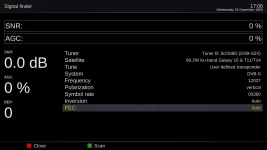
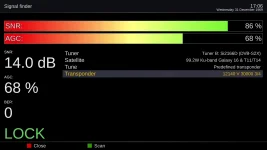
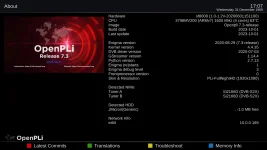
el bandido
TNAP-Images
Define....LOL. This must be a Rick Caylor receiver, although some others may ship like that. Complete with Ancient hacking key file no doubt.
Anyway, you may have to move the frequency up and down a bit before that transponder will work. Si2166D should resolve it. Without getting too technical, there is a thing called a timeout, and TNAP is set unusually long for low symbol rates to give more capture time. You can see what I am talking about if you simply try to scan that frequency in OpenPli 7.3, and time the amount of time it takes for the scan attempt, then do the same thing with TNAP, and you should see a noticeable scan time difference. But none of that helps if you cannot receive the signal, right?
You might try a couple of things, 1 would be to simply leave it tuned like you have shown for a good twenty-30 minutes and see if the signal ever shows up. And you may try adjusting the frequency a bit 1 MHz at a time in either direction. The drivers appear to be the same in PLi 7.3, so TNAP might have an advantage due to the longer timeout for low symbol rate. But at the end of the day, No signal is no signal. Another thing you might try to do is scan, signal or not. I have had that work before.
Also, that V3 will skip some large symbol rate transponders. I remember a complaint about that. It will skip some transponders in blindscan, but will resolve them in manual scan. Almost every fta receiver does that to a degree. Blindscan is a crapshoot.
Anyway, you may have to move the frequency up and down a bit before that transponder will work. Si2166D should resolve it. Without getting too technical, there is a thing called a timeout, and TNAP is set unusually long for low symbol rates to give more capture time. You can see what I am talking about if you simply try to scan that frequency in OpenPli 7.3, and time the amount of time it takes for the scan attempt, then do the same thing with TNAP, and you should see a noticeable scan time difference. But none of that helps if you cannot receive the signal, right?
You might try a couple of things, 1 would be to simply leave it tuned like you have shown for a good twenty-30 minutes and see if the signal ever shows up. And you may try adjusting the frequency a bit 1 MHz at a time in either direction. The drivers appear to be the same in PLi 7.3, so TNAP might have an advantage due to the longer timeout for low symbol rate. But at the end of the day, No signal is no signal. Another thing you might try to do is scan, signal or not. I have had that work before.
Also, that V3 will skip some large symbol rate transponders. I remember a complaint about that. It will skip some transponders in blindscan, but will resolve them in manual scan. Almost every fta receiver does that to a degree. Blindscan is a crapshoot.
Thanks. I'm happy to experiment and try different things to make it work; I'm a "low symbol rate enthusiast" so I was really hoping this new unit would provide me some happy hunting.
el bandido
TNAP-Images
It is what it is. Maybe a decent receiver will show up one day. I also see you have a 10. ip for the box. Don't see that very often. If you are running a static network ip, TNAP has a free Wireguard VPN available if desired.