How To Look For & Find 5G Interference in C Band

More parts have been purchased that should allow the TinySA analyzer to "see" the signals coming directly from the c band lnb. This will be little bit more messy because the analyzer will read the frequencies that the lnb has down-converted. These frequencies will be in the 950-2150 MHz range for my lnb. The frequencies will have to be read from the analyzer, then calculated using the lnb l.o. frequency. This is no big deal, but it is not as easy as reading what the analyzer displays.

I think it was assumed that the frequencies between 3.8 to about 4.0 GHz would not be used until the end of 2023. Apparently this is not the case for my neighborhood, or the TinySA Ultra doesn't know what frequency it is displaying. All of the other frequencies on the TinySA have been found where they would expect to be found, So I am fairly certain that the 3.8-3.9 GHz frequencies the TinySA shows coming from the cell tower are correct.

It would not do any good to purchase a Titanium C138 LNBF which specifically is designed to filter out 3.5 to 3.8 GHz when the interference is above 3.8 GHz. This may explain why some have purchased this lnb and had it solve their reception issues. But others have purchased it and still have the interference or reception issue. If you don't have any way of checking the frequencies, then you have no way of knowing if the parts you purchased are the parts you need!
 
Excellent idea Mememeth! I have no c band reception issues at the present time.

A map shows T-Mobile Did Not buy any satellite c band spectrum for my area. Also, my T-Mobile gateway does not support c band operations.

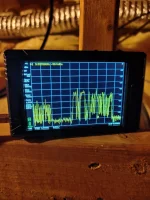
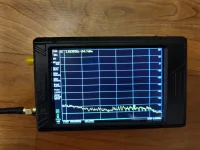
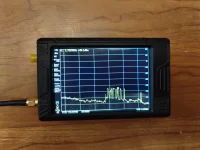
Shown below is a scan using a vertical antenna outside. The scan shown earlier was connected to an antenna mounted on the tower and aimed at the cell tower. This explains the big difference in signal strength.

In the photo below, you will set three sets of spikes. The set to the far left is the 600-900 MHz frequencies that are on the cell tower. These are the tallest spikes and also the strongest. The middle set of spikes is the cell bands around 1900-2500 MHz or 1.9-2.5 GHz. The set of spikes to the far right is satellite c band signals on the cell tower that are around 3900 MHz according to this analyzer. It should be noted that the c band cell signals are about as strong as the 1900-2500 signals, but are not as strong as the 600-900 MHz cell signals.

View attachment 17580

Elbandido, is it possible to narrow the band range on your TinySA so as to see more detail on those 3900mhz signals?

Curious to see how wide spread the interference would be if the signals were actually entering into your C Band equipment.
Thanks.
 
You can narrow the band range down as much as you want.

The next step will be looking into the lnb and see what kind of signals ARE entering the lnb. Just waiting on the proper parts to do this...
 
5G C band interference parts Are Not Refundable!

This means if you buy lnb's or other parts such as filters, there will be no refund if the parts do not solve the interference! Below is One example.

From Titanium Satellite website:
https://www.titaniumsatellite.com/p...Band-Pass-Filter/p/412492561/category=6743545

We accept and refund for new and unused or tested defective LNBFs. Our product is not intended to be used as a trouble shooting or system testing device that is returned after testing. We will not refund if our bench testing indicates that a returned product, with defective claim is functioning as designed. When a returned LNBF is tested on our bench and determined to be operating within specification, the buyer is responsible for all inbound and outbound return shipping and handling costs. Returns requests and refunds will only be processed directly from Titanium Satellite. Tested items can be reclaimed within 30 days after we email the results status notification. Unclaimed products will be considered abandoned and may be disposed of after 30 days.

I cannot blame them for doing this. Once you install the parts, they are used and are no longer new. It's that simple. It would be nice if some sort of a test kit could be rented, where you pay only for the parts you need. Doubt that happens though. Unless you want to take chances or gamble, understand what you need and why before you buy any interference parts.
 
Basically what happens is your noise floor gets raised when a c band satellite dish gets interference from cellular 5G C band frequencies. Most of our satellite services are in DVB-S or DVB-S2 format. 5G c band cellular is neither DVB-S or DVB-S2, so you could say our fta receivers see the 5G C band cellular as noise.

So let's say your noise floor on your c band dish antenna looks something like this Without 5G c band cellular signals:
IMG_20230113_230231.webp


We could give this as an example of what the noise floor looks like on the same c band dish With 5G c band cellular signals:
IMG_20230113_231130.webp

The job of the 5G C band interference filter is to return the noise floor to a level that is usable. Really nothing more than that. Some of the unwanted noise may be filtered out using electronics (5G C band interference lnbs) and or mechanical signal filters.

A mechanical interference filter more or less puts up a barrier where the wanted signals can get in, and the unwanted signals cannot get in (rejected). A good mechanical filter for c band satellite microwave will cost money, but it is very efficient at its job.

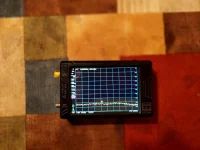
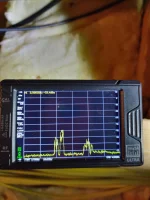
As for narrowing the signal down on the TinySA Ultra, the second picture shown above was taken using a range of 3.9 GHz to 3.95 GHz coming from my local cell tower using a gain antenna. You may adjust the range up or down to suit your needs.
 
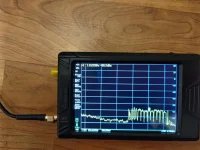
I now have the proper connectors to connect the TinySA analyzer directly to the lnb. Now I have an idea an idea of what signals the fta satellite receiver "sees".

Note: Protect the analyzer from any voltage that may come form the lnb. Failure to do this will result in a dead analyzer!

The signals around 3900 MHz that appear to be coming from the local cell tower bother me a little bit. I wanted to see how much interference my satellite dish is getting with these signals. The first thing to do was get an idea of what signals are currently coming from the cell tower and some idea of signal strength.

For this test, we will use 3.9365 GHz (3936.5 MHZ)
IMG_20230119_193958_hdr.webp


Next, The analyzer is connected to the satellite lnb, The dish was moved to 87w which is almost aimed directly at the cell tower. My lnb has a l.o. of 5750 MHz, and and a frequency range of about 1.2 GHz. This makes my line frequencies roughly 950-2150.

To see what is on 87w, I set the analyzer to scan 950-2150 MHz.
IMG_20230119_200356_hdr.webp

We are looking for 3936.5 MHZ or something real close to it. So we have: 5750-3936 = 1814.
Look closely at the above picture and you will see 1.8132GHz (1813.2 MHZ) in the top left hand corner. This frequency is also marked with a symbol above the top of it for identification.

Next question would be: "Is this a cell tower frequency on the satellite dish?". To answer this, we move the dish a couple of degrees and see what happens.
IMG_20230119_200622_hdr.webp

Moving the dish roughly two degrees puts the possible cell tower frequency down in the noise floor. I don't have anything to worry about right now.


The last question would be: " Is a signal with a frequency of 3936.5 MHZ really coming from the cell tower? I can't 100% answer that question, but the analyzer seems to think so. Several cell towers have been tested in my area with this analyzer, and all of them show roughly the same group of 3.8 - 3.9 GHz signals coming from the cell tower. These towers are not in an area that has licensed earth stations or large commercial c band dishes. So I assume the analyzer is reading correctly.
 
There is a transponder on 105w that has a frequency around 3712 MHz, vertical polarization. This transponder contains one tv channel, and has been suspected of having 5G interference, which may or may not be true. At any rate, sometimes this channel will play fine for me, but other times it will pixelate and have artifacts that make it UN-watchable.

The analyzer works the same as scanning a satellite: You can only scan one polarity at a time, and both polarities need to be scanned in order to "see" everything. For the analyzer, I select a horizontal or vertical transponder using the receiver's remote then let the analyzer scan. Then I repeat for the opposite polarity.

A vertical scan of 105w shows the 3712 transponder almost all the way to the right of the screen sitting by itself.
IMG_20230120_010450_hdr.webp

One thing I notice about this transponder is it has a shorter spike than the rest of the transponders to the left on the vertical side of this satellite. Another thing to notice is the 3712 transponder is sitting pretty much by itself. You would expect to have signal spikes all around it or even above it if this transponder was getting 5G c band interference.


So I conclude that my problems with the channel on 3712 MHz are not due to cellular c band interference, But it does have problems. Shown below is a screencap of the channel with interference. Not shown but also happening is the signal will jump from around 15 db to around 10db (snr). The picture also freezes at times.

1_0_1_1_0_0_9F58E80_0_0_0_20230120114240.webp
 
Warning!!! The following is speculation.
Is this possible?

With the TinySA setup parallel to a receiver as described previously. (Or better to use a power inserter instead of a receiver?)
Insert a splitter between the multi-switch and dish so that BOTH the H and V lnb's are powered. Then the TinySA could scan both polarities at once.

Or would something go boom?
Geese fly north for the winter. Cats and dogs start shacking up together. Sun rise in the West. Universe collapse into a black hole. :shocked22:
 
Last edited:
At minimum, you would be trying to combine two antennas without using anything to properly combine them. We want to get an idea of what signals the receiver is having to deal with. Combining both polarities might give an idea as to what is on the satellite, but it would not help to understand what the receiver sees because the fta receiver is not designed to receive both polarities at the same time.

True cell tower interference may be seen on both polarities of the lnb. The reason for this is cell tower signals are designed to work whether the cell phone or cellular device is facing up, down, or sideways.

I have also seen the idea of using a lnb to hunt for 5G cellular signals. Some seem to think there is something magical about the lnb that allows it to amplify signals. The only signals the lnb can amplify by itself are the line frequencies. The lnb gets its signal amplification from the satellite dish. The lnb antenna is only a single dipole( or a dual dipole if the lnb is dual polarity).
 
Haven't managed to setup a 5g 'wardriver' yet. Looks like T-Mobile setup 5G service in a few towers here recently. Fortunately they are off axis and behind my dish miles away and not in LOS of it.
So far in youse guys (lol) experimentation. Does it appear as if major interference is only in a situation where the dish is a few degrees of LOS of a tower?
Or is it possible interference may be possible from side lobes also?
I had some heavy thinking remembering my analog cell phone and pager days where we worked in screen rooms.
When the door closed. All external RF was as close as possible 100% attenuated.
Since my assumption at the moment is that 5G is of a frequency high enough to give a narrow beam. As EB stated.
I'm wondering if a frame of some size. Maybe not too big. With metal window screen on both sides and earth grounded. In between the dish and tower.
If that wouldn't attenuate interference at all. Just a concept.

Brian is a real good dude. I would never treat him as a Best Buy or wally world. Can't blame him at all for the no return statement. I mean, if an lnbf was borked out of box. Hopefully he would oblige.
 
T-Mobile Home Internet and T-Mobile cellular services have only a small amount of frequencies in the 3.5 - 4 GHz range. You probably don't need to worry about T-Mobile unless you are in a highly populated, Urban area. Verizon and ATT can operate somewhere in the 3.5 to 4 GHz on almost every cell tower in the United States. The cellular services in the 3.5 - 4 GHz range will not effect your c band satellite dish unless enough unwanted signal collects on the dish and overloads the lnb. It's that simple.

Studies on cell tower interference in c band are usually within 300 meters of the tower. In other words, your satellite dish needs to be within 300 meters of the cell tower if you want to have a decent chance of interference from the cell tower. Studies are studies, but a distance of 300 meters from the cell tower seems reasonable when you think about it, Satellite dishes point up, towards the sky and are very directional.

Some wildcards for c band satellite interference are micro or mini-cells, Internet gateways connected to c band frequencies, and possibly cell phones operating on c band frequencies. Instructions for cellular Internet gateways suggest installing the gate near a window. So it is easy to see Internet gateways interfering with c band satellite dishes in crowded neighborhoods.

What to do or what to put up will depend on where the interference is coming from and how strong it is. Hardly any two interference situations will be the exact same. Surely it would be possible to put up large mesh panels and block part if not all of the interference, but what would the yard look like afterwards? Most c band hobbyists will need to move - relocate the dish or install filters if they are experiencing in-band interference.
 
Arlo, I have not had any 5G interference to deal with yet, so I couldn't say. Hope I never do!

I always had glitches between my two bud systems using lnbf's. Switching to dual lnb feedhorns (as EB suggested) was the only cure I found for it. I hope to never go back to lnbf's... BUT... I would hate to buy 4 wave guides and/or 4 new 5G blocking lnb's Ouch! Of course if every needed in the future, the cost of wave guides and 5G blocking lnb's may be less in the future.

Also: Wife would lose several lower freq channels she likes on the Atlantic sats.

My distance from the main road and protection from hills/trees may prevent any towers from bothering me. A neighbors cell phone or home internet device would be the most likely culprit here.
 
If you are surrounded by trees instead of buildings, and your nearest neighbor is 500 feet or more away, then you probably will not have any cellular c band problems.

A 3.5- 4 GHz frequency is going to act like a shotgun. When you are close to the transmitting source, you will get the full effect of the signal. The 3.5 - 4 GHz frequency will scatter fast as you move away from it. Obstructions like trees and hills will speed up the signal scatter at these frequencies.

A yagi or highly directional beam type antenna will usually be recommended when you have direct, unobstructed view to a cell tower, and are trying to increase the signal from it. A panel type antenna will usually be recommended when you have trees or other instructions in front of a cell tower, and are trying to increase the signal from it. The reasoning for this is simple: A yagi has a tighter beam and is more directional. A panel antenna has a much wider beam as compared to a yagi and could be more useful for collecting a scattered signal.

When dealing with interference, you have to know where the interfering signal is coming from and at least have some idea of how strong it is. This is the first step if you want to have success.
 
I'm good for a long time. 300m is a good enough figure to know I'll probably never get any interference. Towers are N and NE of me and even though I can see the beacon lights at night of the due north towers, they are at least 5 miles away. Whatever that works out in km is up to ya'll.
Hey man. Who wouldn't want a big fly swatter in their yard? Heh! There is this guy here that had a bed spring on pulleys in a tree who hoisted it up and down to to get the Bills game. That blew me away. And....it actually seemed to work even with a deep fringe antenna on his house. Go figure.

I've made patch antennas for L band Inmarsat.
The REC put in fiber. I still have cable. Subbed to 100mbps service and recently found out they upped it to 200mbps for the same price. Pretty cool. Fiber is 5 bucks more a month.
What's cool is I built a 2.4 GHz 14 element yagi and put DD-WRT on a Netgear R7000 router. Running it in client bridge mode.
My "neighbor" (I live in the stixx) is about 3/4km away from me through trees. I house watch for him in the winter when they hit Fl.
Pretty good signal and it's bridged to my LAN.

The big worry was potential lobe interference on my dish. So 300m settles my mind. Still a bit amazed that Othernet can use a bare ku lnbf pointed at a satellite w/o a dish and get signal.
So the bare C band lnbf for a "rifle scope" to hunt out 5G spectrum was a thought.

Finding and getting a quality orthomode and a couple of Norsats has crossed my mind. Its just that from all of the reading here and there. The wow factor don't justify it. But....does it guys?
I mean. There's "Corvette Joe" here. A Belgian dude. He's had Ferarris, Porsche's. Has a photo of him and Enzo with arms around each other's shoulders.
He was at the local body shop getting his CTS from some stone chip repair. Not actually bragging. "Adamant". Of how fast his cars were.
The body shop owner muttered about a car in the lot that would blow them all away. Mind you that was before Hellcats came out.
Joe looked and asked where?? The shop owner told him the silver 4 door. Joe went out and made a couple of circles around it. Kind of "meh". We talked. I popped the hood. He checked things out.
Rocky (shop owner) said "Give him a rip". I asked him if he wanted. So Joe got in. Headed out to the edge of town. Just enough RPM's and boost to make him thing "That's it?!!!"
Hit an open stretch and opened it up after switching to the track map with the trik cruise control button mod.
All he did was stiffen up and eye locked the tach and speedo. Holyshitholyshitholyshitholyshit. That's all he said. And had Tourette's on and off for the next 15 minutes after we got back to the shop.
Haha. Not bragging. It is what it is. But...

Will I get similar reaction with an ortho/Norsat setup on my 12 footer (you do the metric convershion)? Would a Corotor do the same? I have a box of them. They need a teardown and bead blasted and powder coated.
 
Walking around the yard while using a c band lnb for an antenna would be a messy experience at best. I think you would be better off using a small yagi that is designed to operate on c band instead. Try it and see.

As for changing lnbs, you usually get what you pay for. New Japan Radio (NJR), and Norsat are two common brands that you will see at commercial satellite sites. But if you don't know WHY you are changing lnbs, then you probably shouldn't.
 
The reason it is possible for Othernet users to get a signal without using a dish is the signal strength that is needed.
Here is a quote from the Dreamcatcher user manual for Othernet:
Lower Rssi levels such as -100 dBm may carry signal, but the
Dreamcatcher is not sensitive enough below -95 dBm

Usually a fta receiver will have tuner specs between -30dbm and -60dbm. Othernet Dreamcatcher is looking for a signal value between -60dbm and -95 dBm. So Othernet can operate using a signal that is 1000 times weaker than what a fta receiver needs as a minimum requirement. Ditto the amount of information being sent and the Othernet frequency width.


I also notice the Edision MIO+ doesn't play or has trouble playing channels when the TinySA Ultra shows the transponder signal at or around -60dbm. Every frequency I have been able to check and verify on the TinySA Ultra seem to be where they are supposed to be. Satellite beacon frequencies displayed on the TinySa Ultra are almost identical to what is advertised.
 
It goes back to the VU+ guy with 'roll your own' tuners. He's getting channels and tp's that the mio is blind to.
My weak mind is saying what if a receiver with a hot tuner combined with sensitive lnb's were used.

'dillo mentioned in #54 of troubles. Assuming he went to an orthomode setup fixed the glitches he experienced. Wondering what the glitches actually were.
Mine is a C2-W. One output of it went weak. Perhaps because the F connectors were loose from factory. I don't know. Haven't cracked it open to check. Sometimes the center connector turns inside the teflon independent of the outer fitting. That's a good thing. Sometimes not. Stressing the connection to whatever it's soldered to.

Makes total sense now Othernet working with low dB levels. It just never occurred that an lna/lnb could even work at all w/o a 'mirror' to concentrate signal at the throat.
Low signal, low data rates, and good error correction seems to work well on the Dreamcatcher. When it was Outernet all of the signal processing was done in software.

Making and tweaking the 2.4 GHz yagi took a bit of doing. Up that a gig in freq. and who knows. Even with 12 elements for directors I see frontal lobes several degrees from center.
Here I used telescoping brass hobby tubing and a fiberglass driveway marker rod. Starting with a dipole for the active element and tuning to length with the trusty HP network analyzer.
Switched to a folded dipole and loop match. Worked much better and more stable. Wow. 4 GHz might be a bit of a challenge. You just look at it and SWR/return loss is all over the place.
So maybe an all in one, factory tweaked lnbf really doesn't sound that far-fetched. Strap a couple of 9V's in series and a DC block.
I'm steering towards a lower amplified working freq. and feeding an SDR. Lets see.
Projects!
 
Vu+ produced great subscription boxes. Vu+ satellite receivers do not perform exceptionally well as a fta receiver. But if you think they are that great, then buy one or two. Also, the pluggable tuner thingy is Wonderful! That is until you turn on the receiver and find the tuner is not recognized. Then the pluggable tuners are not Wonderful anymore. But again, buy one and see for yourself. Great subscription box!

Usually making a home-made antenna costs more than what you could buy the antenna for. Problem is, you don't learn much buying an antenna pre-made. Good job with the homemade antenna!


The strongest 2-3 GHz signal I could find around here with the TinySA was between -20dbm and -30 dbm. The signals came from a wireless router and cellphone. Both items were a few feet from the TinySA when these measurements were recorded.

My satellite noise floor seems to run around -70dbm. The documentation I have read says that reducing an unwanted signal to -55dbm will probably take care of any interference issue. So if I had a -30dbm unwanted signal that was interfering with c band, a filter of -25 db would take it down to -55dbm. A 45db filter would take the unwanted signal down to -75dbm. Providing of course the filters worked in the same frequency range as the unwanted signal. This is one way to use the TinySA analyzer to determine what you need to solve interference issues.
 
...'dillo mentioned in #54 of troubles. Assuming he went to an orthomode setup fixed the glitches he experienced. Wondering what the glitches actually were...

Arlo, It was a long running mini-series over at Hyper's old site. I have TWO 10ft buds feeding 3 - 4 receivers. (Receiver #'s vary at times) Was running a dual lnbf on each bud. Had voltage (?) interaction between receivers. Wherever we would change channels on one receiver it would often glitch the other receivers. (Especially when receivers were using opposite buds) Either had to wait for signals to stabilize or reboot the receivers. Tried different: lnbf's, diseqce switches, multi-switches, etc.

The only cure was running dual feed horns with lnb's instead of lnbf's.

I can't say I got any real signal increase running the dual feed horns. If anything, mine are slightly inferior on many transponders. I'm sure it would be better if I wasn't running bargain basement lnb's.

Money can't buy the peace and quiet those dual feed horns finally brought me. lmao
 
Back
Top