Satellite Orbit Identification in TNAP Images

el bandido

TNAP-Images
Some form of satellite identification has existed in FTA receivers for years. Satellite identification was prominently displayed in most FTA receivers that were made from 2003 to around 2010. FTA receivers from this era used binary or bin files that were updated regularly. No foolproof system existed. A lot of C band and linear Ku band satellites were identified incorrectly in FTA receivers from that era.

Loading an updated bin file into the FTA receiver allowed for the satellite information to also be updated. Updating the satellite information on a regular basis allowed the satellite identification system to be more accurate. Satellite identification in a FTA receiver is made possible by reading the transponder Network Information Table (NIT) or by checking for lock on a list of transponders that are associated with a satellite orbit location.

Professional grade satellite receivers and professional grade satellite signal meters may get the Correct Satellite Orbit and Satellite Identification by using the satellite beacon. Consumer FTA satellite receivers Do Not Have satellite beacon reception capability, so this method of satellite orbit identification is not available on consumer grade FTA satellite receivers.

The design of TNAP images recognizes the limits of satellite identification, so efforts in the various menus to identify a satellite orbit location are limited or do not exist. The Network Information Table or NIT usually works great on circular type Ku satellites, and also may work to a degree on linear Ku satellites to determine orbit location. NIT works poorly on North American C band satellites, to the point of being almost useless.

TNAP could employ the technique of Yesteryear and use transponder lock for satellite orbit location identification. The problem though is someone or a group of people would need to constantly assist in providing good transponder information to be used with satellite orbit identification. And still we would not have a foolproof satellite orbit identification system.

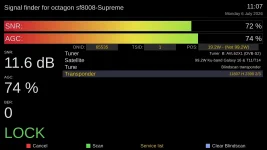
Recognizing the limits of satellite orbit identification, the best that can be done in TNAP for satellite orbit identification is to provide a NIT search for the satellite transponders that are found in a blindscan. We previously made available the ability to load the list of transponders that are found in blindscan into the Signal finder plugin. To complement this, a search for NIT has been added to Signal finder, but seeing the results will depend upon the skin being used.

TNAP 7 images dated after 06-10-2026 should have the Option to perform a NIT search at the end of a blindscan to determine or aid in proper satellite orbit location, and also have an automatic NIT search in the Signal finder. But once again, the ability to see the NIT search in the Signal finder plugin will depend on the skin being used.
 
The old Enigma1 respected the flag setting in satellites.xml, and the search was adjusted accordingly. Enigma2 ignores this flag.

useable flags are
0 - none
1 - Network Scan
2 - use BAT
4 - use ONIT (extended network search)
8 - skip NITs of known networks
and combinations of this.

<satellites>
<sat name="Telstar14R/19V (63.0W)" flags="2" position="-630">
...
 
Last edited:
For example, with flag 2 in satellites.xml, the satellite scan in Enigma 1 created user bouquets based on the BAT broadcast on PID 17
capture_001_11062026_060313.webp
Or flag 8, which ignores the NIT if it is listed in satellites.xml
...
 
Well that is great! But what does it have to do with satellite orbit identification? Nothing that I can see. A totally different subject you are talking about.
 
If the ONID/TID is also listed in satellites.xml, it is quite easy to determine the location based on the transponders found, since the information in the NIT is not always reliable. Yeah, I was thinking of something else - oops.
 
...TNAP 7 images dated after 06-10-2026 should have the Option to perform a NIT search at the end of a blindscan to determine or aid in proper satellite orbit location, and also have an automatic NIT search in the Signal finder...
My receiver is now offering the option at the end of blind scans and is automatically performing the search in my Signal Finder. I remember back when doing my very first dish orientation long ago wondering why, with all the data sent by the satellite to a receiver, the information didn't also include the obviously needed satellite position so you'd know what your dish was pointing at. So it's kind of cool to see the satellite position being reported now at least some of the time via the NIT data. Though I don't actually need it anymore since I now know everything that is regularly on each Ku satellite.
 
Hello folks and welcome to the show. Interesting subject.
I believe it was even here in the past that I had asked why satellite identification was missing in E2 images.
It was so far-fetched for some that they couldn't grasp the idea. My thoughts were that somehow the beacon or perhaps data that was in the DVB stream. Dependent or independent of the receiver firmware and file system.
"Crazy", "Preposterous", many different versions of I-don't-get-it stuff.

Truth be told that when I got into this FTA thing and playing around with the Dish Network equipment laying around.
Getting a Dreamlink T5 and Linkbox 8000 (something) later on. Not exactly understanding local oscillator frequencies of diseqc settings.
Just trying to snag a signal to see what was on them. Waiting for preview events and stuff.

If I used the signal finder/setup screen on the T5 and aimed to get a signal. The receiver told me dead-knutz what satellite I was aimed at.
Happen to be trying for 99W and aimed at 101W. Satellites that share the same transponder parameters that are neighbors or even several vague degrees off in the arc.
In that receiver if you had the transponder settings dialed in and set in the signal finder screen.
Indeed if you were aimed at "any" (that I knew of at the time) satellite and got signal. No touching, no fiddling, no scanning at all.
The satellite's ID, orbital position, whatever. Would pop-up in the window.

Receiver set for....ohhh....let's say 121W. But actually aimed at 125W. Same transponder parameters in the setup screen. But aimed at the wrong damned satellite?
125W <satellite name> showed in the screen. When I finally did get pointed at the intended sat., That name popped-up in the screen.

I could probably crack that sucker (the T5) out today and hook it up to my polar mount. Find a signal somewhere. And I'd see the actual satellite name on the screen. Set for satellite X but actually aimed at satellite Y? X in the screen, when signal is attained. Y shows as the beacon ID of the received signal. Like "Hey, Here I Am".
 
The Ku satellites you mention, 99,101,125..etc are/were Provider satellites and usually had at least decent NIT tables. But when you started looking at FTA satellites such as 78,83,85,87,89 c or ku then you would start seeing the accurate satellite identification take a nose-dive. The Atlantic FTA satellites were the worst and almost always failed on consumer fta satellite receivers that tried to identify them. To go further, you could probably connect a T5 to a satellite dish today that was properly setup and aimed at DishNet 110, 119 west ku and it would still correctly identify it. Transponders and NIT is all that is available for satellite identification for a consumer FTA receiver.

A T5 Does Not have a satellite beacon tuner. Open the case and you will see this. The T5 used the same satellite orbit identification as the rest --Sonicview --Pansat --Viewsat...etc. All that was available to these receivers for orbit identification is or was NIT identification or transponder identification. They did not have the ability to lock that satellite beacon! Hook your T5 or any of the other orbit identifying FTA receivers up and see what you do or do not get in the way of orbit identification. Check the FTA orbits, Not provider orbits. You will get precious little correct information.

Uplinkers do not care. We see this all the time in various places. Shown below is 99w ku being identified as 19.2w. Probably a typo by the uplinker? Either way, the result is the same: Satellite orbit identification in a consumer FTA receiver is not accurate. If any of the previous models of FTA receivers did a proper job of identifying an orbit location, they would be mentioned on FTA forums as the items to have and command a high price when sold.

19.2-99ku_20260706110723.webp
 
Interesting info there , El. All that happened in my change from the chinabox receivers to E2. About the exact same time that I went from az/el ku band dishes to c band. With a polar mount and trying to locate and store positions. The old "bump and scan" to locate satellites.

It was just strange that everyone was asking for features, bells and whistles that a dedicated streaming box would excel at......
I had mentioned having an actual satellite ID.....beacon, pull info, from the datastream. Whatever. Integrated into the firmware.
That is where all of the finger pointing began. "Impossible". "You're getting the info from the satellites.xml (no I wasn't). "There is no way".

Nobody. And I mean nobody. With a closet full of satellite receivers. Would yank one like the T5, Linkbox, etc. out and check my sanity.
So. An actual bell and a whistle thrown in is cool. Still wonder why nobody has found a way to integrate a BT KB and mouse. On screen keyboards are handy. Different "stack" needed? It's just damned nice with an Amazon, Apple streamer to enter searches using a friendly HID. L,R,U,D, Okay (enter). A pain.

Anyway. Some years ago. More actually I guess. Seems like yesterday. Your doctor would listen to you and say "Son, son, you've gone too far.
`cause smokin' and trippin' is all that you do."
Now he himself can. Without any weed or blotters at all. Drive through any club district, in most any city on a busy nigh,t and tell you.....
"Yeah, fairies wear boots and you gotta believe me."
"Yeah I saw it, I saw it, I tell you no lies."
 
I have a pretty decent collection of fta receivers ranging beyond a 20 year period. The problem is the remotes. Most of the remotes either quit working, had problems, or are nowhere to be found. All of the receivers I have had that have satellite identification may identify satellites correctly at times, but also either do not identify the satellite or identify the satellite at the wrong orbit location.

Here is a conversation about fta receiver satellite id from 2016:
"It often wrongly ID's the Satellite though,which had me confuzzeled.Might be on 97W and it says 139W is locked,for instance."

Satellite identification in a FTA has only two possibilities. One is locking the satellite beacon and getting the public information from it. The other is to use transponders. We can rule out locking the satellite beacon because no consumer FTA receiver has that capability that I know of.

Identifying a satellite by transponder frequency, NIT, or by other means associated with the transponder may work but will also provide either no information or wrong information. Some of the transponders on 97w ku band have not changed in years. This satellite can be used to demonstrate what the older fta receivers are capable of when it comes to satellite identification.

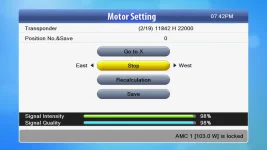
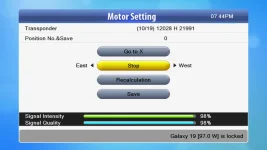
Shown below are recent screenshots from a Linkbox 9000i receiver which is an updated version of the 8000i. The actual satellite is Galaxy 19, 97w ku.

Galaxy 19 is identified as AMC 1 103w:
vlcsnap-2026-07-18-10h11m56s620.webp


The satellite is identified correctly as Galaxy 19:
vlcsnap-2026-07-18-10h45m06s689.webp
 
Back
Top