Vu+ produced great subscription boxes. Vu+ satellite receivers do not perform exceptionally well as a fta receiver. But if you think they are that great, then buy one or two. Also, the pluggable tuner thingy is Wonderful! That is until you turn on the receiver and find the tuner is not recognized. Then the pluggable tuners are not Wonderful anymore. But again, buy one and see for yourself. Great subscription box!
Oh hell! Not exactly the point I was getting at. Actually as you know. I was pondering of grabbing one from a dude on linuxsat who offered to get one (he's an admin there) and ship to me as a gift to give it a whirl over here. Because he's friends with World of Satellite I was given the option to test it for an extended period after the return policy. Pretty cool, huh? Of course I'd pay him for it. The bottleneck was what tuner or tuners to pick that would work here. As for not recognized (tuners). I didn't tear the latest TNAP down to see how many tuner drivers you include. I would suspect only the custom AVL drivers for the mio(s). Makes sense. Adding drivers for let's say and external USB tuner shouldn't be difficult...not saying dealing with anything Linux is ever easy. Lol!!
I'd have to say since he's getting more FTA channels and getting them better with more signal strength where the mio craps out or is blind. He made his point.
Pluggable tuners a "thingy"? Kinda like saying a dish with a welded on lna/lnbf would not be a "thingy" don't you think? I ain't going to run out and buy a VU+ or any other new receiver unless it's a TBS card anytime soon.
I want to put something into perspective. I've been into amateur radio since like forever. My dad and I had out tickets when I turned 10. And 10 was a long time ago.
Anyhow. Some years ago I purchased an unblocked Icom IC-R8500. Enjoyed it for years besides my stack of boat anchor radios. Love the smell of coffee and tubes in the morning.
A few years back I purchased an IC-R8600. And the stock brick power supply. It didn't take long to find it just didn't have the sensitivity in HF/VHF that the 8500 had. Unbelievable, right!
Antennas...check, cables.....check, all that. Being new and under warranty I didn't even screw with it. I boxed it up and sent it to Michigan to Icom's service center.
Got it back in flying colors. It met and exceeded factory specs. With a printout of actual test results. So. What's the deal? Sensitivity sucked still compared to other radios.
Crap. The switching power supply was the culprit. I sent it in too at the time. My R8500 had a linear power supply. No noise, no hash. The R8600 with a linear or battery is simply amazing now.
So. Back to your VU+ thingy. A guy with one satellite receiver. The mio because it was the cat's ass and everyone said to grab it. Or the dude who gets a zap that kills the tuner rendering the receiver a boat anchor. Kind of makes it an Apple Mac that borks a graphics card or whatever on a Friday. Not an easy thing to blast to the pc store and grab any old GPU and slap it in and you're golden.
The dude that proved his receiver got things that the mio didn't by a heavy margin. And proved it, made a very good point. Dontcha' think?
Yeah. I kinda' repeated myself. In case the mio ears didn't grab it on the first scan.
It's cool. Smack that kiss my ass button. I'm a good humored person. If you're a brit you can add an extra "u".
Usually making a home-made antenna costs more than what you could buy the antenna for. Problem is, you don't learn much buying an antenna pre-made. Good job with the homemade antenna!
Actually maybe not. With folks like jlpcb out there it would be easy enough to design a few different yagi, log periodic antennas and have different flavors ready in a few days for a few bucks on epoxy boards.
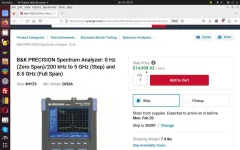
On the 'tube Andrew McNeill is the antenna guru . He actually inspired me to get my old-assed HP network analyzer. I love it. He does enough reviews of store bought purpose designed antennas to show that most are crap. Ace Hardware has all the hobby metals and tubing I ever needed. Ebay has given me sources for the best American made coax chunks and fittings I ever needed. Search "nearest first" and in a day or three as Kelly Bundy said...."Vi-Ola".
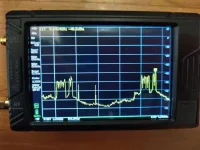
The strongest 2-3 GHz signal I could find around here with the TinySA was between -20dbm and -30 dbm. The signals came from a wireless router and cellphone. Both items were a few feet from the TinySA when these measurements were recorded.
My satellite noise floor seems to run around -70dbm. The documentation I have read says that reducing an unwanted signal to -55dbm will probably take care of any interference issue. So if I had a -30dbm unwanted signal that was interfering with c band, a filter of -25 db would take it down to -55dbm. A 45db filter would take the unwanted signal down to -75dbm. Providing of course the filters worked in the same frequency range as the unwanted signal. This is one way to use the TinySA analyzer to determine what you need to solve interference issues.
The geekery is not so geeky to me. I'd be interested to learn your findings for off axis persistence. In other words if you landed on 127W and a band of transponders were overwhelmed with 5G interference. In a normal situation shifting the dish 2 degrees E/W you would lose a channel (tp). How many degrees would 5G interference keep blowing into the dish and focusing on the lnbf?