How To Look For & Find 5G Interference in C Band

Vu+ produced great subscription boxes. Vu+ satellite receivers do not perform exceptionally well as a fta receiver. But if you think they are that great, then buy one or two. Also, the pluggable tuner thingy is Wonderful! That is until you turn on the receiver and find the tuner is not recognized. Then the pluggable tuners are not Wonderful anymore. But again, buy one and see for yourself. Great subscription box!

Oh hell! Not exactly the point I was getting at. Actually as you know. I was pondering of grabbing one from a dude on linuxsat who offered to get one (he's an admin there) and ship to me as a gift to give it a whirl over here. Because he's friends with World of Satellite I was given the option to test it for an extended period after the return policy. Pretty cool, huh? Of course I'd pay him for it. The bottleneck was what tuner or tuners to pick that would work here. As for not recognized (tuners). I didn't tear the latest TNAP down to see how many tuner drivers you include. I would suspect only the custom AVL drivers for the mio(s). Makes sense. Adding drivers for let's say and external USB tuner shouldn't be difficult...not saying dealing with anything Linux is ever easy. Lol!!
I'd have to say since he's getting more FTA channels and getting them better with more signal strength where the mio craps out or is blind. He made his point.


Pluggable tuners a "thingy"? Kinda like saying a dish with a welded on lna/lnbf would not be a "thingy" don't you think? I ain't going to run out and buy a VU+ or any other new receiver unless it's a TBS card anytime soon.

I want to put something into perspective. I've been into amateur radio since like forever. My dad and I had out tickets when I turned 10. And 10 was a long time ago.
Anyhow. Some years ago I purchased an unblocked Icom IC-R8500. Enjoyed it for years besides my stack of boat anchor radios. Love the smell of coffee and tubes in the morning.
A few years back I purchased an IC-R8600. And the stock brick power supply. It didn't take long to find it just didn't have the sensitivity in HF/VHF that the 8500 had. Unbelievable, right!
Antennas...check, cables.....check, all that. Being new and under warranty I didn't even screw with it. I boxed it up and sent it to Michigan to Icom's service center.
Got it back in flying colors. It met and exceeded factory specs. With a printout of actual test results. So. What's the deal? Sensitivity sucked still compared to other radios.
Crap. The switching power supply was the culprit. I sent it in too at the time. My R8500 had a linear power supply. No noise, no hash. The R8600 with a linear or battery is simply amazing now.

So. Back to your VU+ thingy. A guy with one satellite receiver. The mio because it was the cat's ass and everyone said to grab it. Or the dude who gets a zap that kills the tuner rendering the receiver a boat anchor. Kind of makes it an Apple Mac that borks a graphics card or whatever on a Friday. Not an easy thing to blast to the pc store and grab any old GPU and slap it in and you're golden.
The dude that proved his receiver got things that the mio didn't by a heavy margin. And proved it, made a very good point. Dontcha' think?
Yeah. I kinda' repeated myself. In case the mio ears didn't grab it on the first scan.
It's cool. Smack that kiss my ass button. I'm a good humored person. If you're a brit you can add an extra "u".


Usually making a home-made antenna costs more than what you could buy the antenna for. Problem is, you don't learn much buying an antenna pre-made. Good job with the homemade antenna!

Actually maybe not. With folks like jlpcb out there it would be easy enough to design a few different yagi, log periodic antennas and have different flavors ready in a few days for a few bucks on epoxy boards.
On the 'tube Andrew McNeill is the antenna guru . He actually inspired me to get my old-assed HP network analyzer. I love it. He does enough reviews of store bought purpose designed antennas to show that most are crap. Ace Hardware has all the hobby metals and tubing I ever needed. Ebay has given me sources for the best American made coax chunks and fittings I ever needed. Search "nearest first" and in a day or three as Kelly Bundy said...."Vi-Ola".


The strongest 2-3 GHz signal I could find around here with the TinySA was between -20dbm and -30 dbm. The signals came from a wireless router and cellphone. Both items were a few feet from the TinySA when these measurements were recorded.

My satellite noise floor seems to run around -70dbm. The documentation I have read says that reducing an unwanted signal to -55dbm will probably take care of any interference issue. So if I had a -30dbm unwanted signal that was interfering with c band, a filter of -25 db would take it down to -55dbm. A 45db filter would take the unwanted signal down to -75dbm. Providing of course the filters worked in the same frequency range as the unwanted signal. This is one way to use the TinySA analyzer to determine what you need to solve interference issues.

The geekery is not so geeky to me. I'd be interested to learn your findings for off axis persistence. In other words if you landed on 127W and a band of transponders were overwhelmed with 5G interference. In a normal situation shifting the dish 2 degrees E/W you would lose a channel (tp). How many degrees would 5G interference keep blowing into the dish and focusing on the lnbf?
 
The geekery is not so geeky to me. I'd be interested to learn your findings for off axis persistence. In other words if you landed on 127W and a band of transponders were overwhelmed with 5G interference. In a normal situation shifting the dish 2 degrees E/W you would lose a channel (tp). How many degrees would 5G interference keep blowing into the dish and focusing on the lnbf?

There is not going to be a set distance to move a dish. Every situation will be different, and everyone does not have the same dish either. A quick look at the analyzer will tell you if in-band interference is present. The idea in moving the dish is to separate the interference from the satellite transponders. If you move the dish a degree or two in each direction and the interference goes away, then you either have no problem or you have a problem with one satellite. Also, separating the in-band interference form the satellite transponders will give a better view of how strong the interference is.

Every situation will be different.


As for the Vu+ tuner decision, you should have gotten what was being used in the MIO test. Simple enough. I guess we will never know the exact make of Vu+ product or the transponders being tested, and how they were being tested. Probably wouldn't matter much even if this information was available. Good luck with Vu+! :bow:
 
I would think 5G interference from a terrestrial source to be harder to turn away from than a sat signal.

Terrestrial signal may be reflecting of trees, hills, buildings etc. Possible coming in from different angles. Stronger signal as well?

IDK how you could determine the specifics, but interesting to contemplate.
 
Put in a simple, general way, The interfering signal has to collect on the dish in a large enough quantity to overload the lnb. The satellite dish looks up towards the sky. The cell tower signal looks down. The cell tower antennas have down-tilt built into them. Micro or mini cells, home internet routers, and even cell phones running c band frequencies can add to or cause interference. If you are in the down-tilt of the cell tower, then you have had a bad day.

No two interference situations will be the same. No two backyards will be the same. And not many satellite dishes will be exactly the same.All things equal, you could expect a smaller satellite dish to have more interference problems than a noticeably larger satellite dish. Then you have the location of the cell tower in the satellite arc. My nearest cell tower is almost due south where the dish is at its highest. Might be a different story for me if the cell tower was at 127w and I wanted to watch 127w. My dish is tilted down a whole lot more at 127w than at 87w.

The idea here is to fully understand what is going on in a particular situation. Once the interference is fully understood, then it can be dealt with (or not). The analyzer will not be clean when in-band interference is present. You can expect see lots of skinny lines mixed in with the transponders, or lots of skinny lines besides the transponders, depending on the frequency of the interference. The lines of interference may be a bit below, equal to, or above the lines for the transponders.
 
I found a couple of videos on the TinySa Ultra that seem to have good and correct information about the product. These videos should be watched by anyone that thinks the TinySa Ultra is not displaying the c band frequencies correctly or within reason. The TinySa Ultra is probably not good enough for precise alignments at some frequencies, which reflects its price.Good, precision analyzers cost thousands of dollars.


Software is available that allows the output of the TinySa Ultra to be displayed on a Modern Windows PC. Full features of the TinySa Ultra are not available in the PC software, but the basics such as scan frequencies are there. Plus there is a record mode.

For those on more of a budget or for those not wanting to spend much money, there are analyzers that work only with a Windows PC for around 40-50 dollars. A video of one of those devices is shown below. A spectrum analyzer like this is not what I want, but it would probably do OK for checking interference in c band. Pay attention to the specs of any small analyzer because some of them only cover in the MHz range. Other small analyzers only cover up to a couple of Gigahertz, but this would be OK for checking signals on a lnb, which would be 950-2150 MHz.


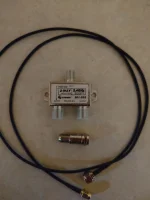
Protect your analyzer or any other device that is connected to the powered lnb by using a splitter that blocks voltage on one side, or a voltage blocking connector. Don't "assume" that the voltage protection device works! Check the voltage on the port Before you connect to it. Even a small amount of voltage on a port will ruin a sensitive analyzer. Shown below are some of the items I purchased for voltage protection.


IMG_20230127_112301_hdr.webp
 
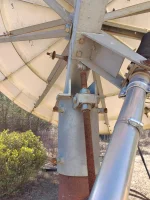
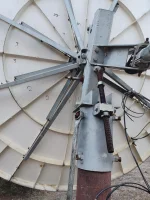
Already discussed is moving the dish East or West to see if the possible interference follows the dish, or to see if the interfering signals can be separated from the satellite signals. The dish can also be moved up or down (North, South). This is something I really don;t won;t to do. I have been blessed with a motorized dish system that requires very little attention. It stops when and where it's supposed to after a move, and the satellite dish has not been aligned in a couple of years.

Anyway, I will probably loosen the the big elevation nut while aimed at 87w and let the dish drop down.There is a multi-switch at the dish that will allow for an analyzer connection to see what happens as the dish drops. It will be interesting to see if the satellite signals disappear and the cellular c band signals get stronger when doing this.


IMG_20230127_112514.webp
 
I would not use a splitter as it will degrade the signals by as much as 3 dB,(or more at higher frequency's) I use an RF sampler, there are some available on line but you can easily build one your self, this link below has one, you can replace the in/out connectors he used with "F" type and what ever type your analyzer needs on the sample output.

Code:
https://www.worldwidedx.com/threads/rf-sampler.32110/
 
Protect your analyzer or any other device that is connected to the powered lnb by using a splitter that blocks voltage on one side, or a voltage blocking connector.....

View attachment 17621

I have a similar setup so that one receiver supplies lnb power. (The other receiver no longer puts out dc voltage)

I have a splitter with voltage block on one side PLUS a dc blocker on the bad receiver. I figured it was safer in case either failed.
 
I would not use a splitter as it will degrade the signals by as much as 3 dB,(or more at higher frequency's) I use an RF sampler, there are some available on line but you can easily build one your self, this link below has one, you can replace the in/out connectors he used with "F" type and what ever type your analyzer needs on the sample output.

Code:
https://www.worldwidedx.com/threads/rf-sampler.32110/

This is an excellent idea, but not many are capable of building such a device. Most of the available samplers seem to be for the low MHz band. I only found one that is anywhere close to the 950-2150MHz frequencies that are required. (See link below.)

https://www.ebay.com/itm/2832356975...bFxJWd4BJ0looiiZwpd8+24Ov5|tkp:Bk9SR-rE492-YQ

Also the lnb has something like 50 db gain for losses in the line. So what's a 3db loss gonna hurt with a line amp like that? FTA Switches are also an insertion loss. Some fta satellite systems have multiple switches installed and seem to work quite well. Granted, don't insert loss if you don't have to, but I have not noticed any degraded or loss of signal during my tests with the splitter installed.
 
I lowered the dish to see what happened with the signal. ALL signals disappeared when the dish was slightly lowered. To check further, I lowered the dish many degrees while watching the analyzer. I got no signals. Nothing!

IMG_20230127_173541.webp


Now what the heck is going on here? The analyzer shows a group of signals around 3800-3900 MHz coming from the cell tower. Seems that since these signals can also be seen in front of the dish, they would also be ON the dish and seen by the lnb. So why does the lnb not see them?

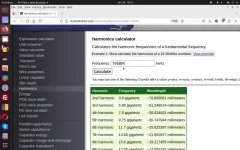
The lnb does not see the signals because they don't exist! Most likely my cell tower has no c band signals on it now. The analyzer is displaying the second harmonic of the 1900 MHz cell band. Harmonic calculator shown below.

Screenshot from 2023-01-28 10-13-36.webp
 
This is an excellent idea, but not many are capable of building such a device. Most of the available samplers seem to be for the low MHz band. I only found one that is anywhere close to the 950-2150MHz frequencies that are required. (See link below.)

https://www.ebay.com/itm/2832356975...bFxJWd4BJ0looiiZwpd8+24Ov5|tkp:Bk9SR-rE492-YQ

Also the lnb has something like 50 db gain for losses in the line. So what's a 3db loss gonna hurt with a line amp like that? FTA Switches are also an insertion loss. Some fta satellite systems have multiple switches installed and seem to work quite well. Granted, don't insert loss if you don't have to, but I have not noticed any degraded or loss of signal during my tests with the splitter installed.

3 Db is one half of your total Rf voltage, or one quarter of your total RF level, and the 50 dB gain is internal to the LNB not on it's output.

The transponder signals coming down from the satellite are in the picovolt (pV) to nanovolt (nV) range, the dish it's self has 40 to 50 dBd of gain to it, the signals coming off the cell tower by the time they get to you can be anywhere around 10 to 100 (or more) millivolts (mV) and can swamp any signal from the satellite at the same or close to frequency.

Now harmonics are a major problem, so is intermod, both are very hard to deal with, I have lost many tons of hair trying to deal with this type of junk back in my broadcast days, there use to be frequency co-ordination but all that went the way of the dodo bird.
 
I don't notice much of a signal drop with the splitter installed. Granted if there was something else readily available to use, I would at least try it.

So I gotta ask:
If the 50 dB gain is internal to the LNB, and not on it's output, Then How can you use 200-300 feet of lossy rg6 to receive the line frequency between 950-2150 MHz signal that comes from the lnb? OR use 100-150 feet of lossy rg6 plus add a few switches, plus a ku motor or c band positioner along they way? Start adding up the line losses in consumer satellite systems and you will usually have At Minimum somewhere between 10-20db of losses in most systems. If these losses are so important, why is there not an interest in eliminating them?

Go out to the dish and connect a 10 foot piece of coax from the lnb mounted on the dish directly to a receiver. Then go in the house and connect to the same dish lnb, but this time using around of 150 feet of cheap rg6 plus some switches. The signal out at the dish is about the same as the signal inside the home, unless there is a hardware problem. How is this possible unless the lnb has a line amp??? Thanks.
 
The receiver has an internal input amp usually controlled by an AGC* circuit, this helps with the loss in the coax, it can range fro 10 to 50 dB depending on the tuner.

All this is usually measured in dBm, so one watt equals 30 dBm, one milliwatt equals 0 dBm, one micowatt equals -30 dBm, one picowatt equals around -127 dBm or dBuV, so add the gain of the dish (lets say +40 dB) your at -87 dB, add the gain of the LNB (lets say +50 dB), your at -37 dB, deduct the signal loss of the coax (lets say -15 dB) your now at -52 dB, and now the receiver has an AGC amp in it so the signal coming in is regulated for a maximum signal without over amping the final signal to the tuners decoder.

*AGC automatic Gain Control
 
Off topic. But not.
It's pretty simple. The intermediate frequency amp will have automatic gain control which tries its best to provide a linear and unsaturated output to the F connector.
I'm not so sure if many remember the heyday of C Band where there was a low noise amplifier with N type connector and immediately after it a boxy downconverter.
Coupled with a very short chunk of microwave coax or a straight (or 90 degree) N type coupler.
Try throwing the LNA output in those frequencies more than a few feet would result in where-the-hell-did-the-signal-go scenario.
I've looked in the box 'o parts and dug out and opened a C Band downconverter from eon's ago and sure enough. There's an AGC feedback circuit.
So yeah. That's why you see little signal loss using your run of the mill RG coax. If you don't kink it. 1 GHz today aint crap.
I'm glad those that jumped and got a tinysa are loving them. It's still a thought.
As with a nanovna, the tinysa running in ultra mode to get way up there in frequencies are doing it sorta' funky.
They work well. But the geekery going on inside of them to get the extended frequencies invites trashy harmonics. Something a bench or dedicated spectrum analyzer natively capable of working microwave freqs wouldn't do.
Now. 2 tinysa's. With an external mixer. Yeah. Now you're cooking. Not saying that one will give an idea of what's out there in the C Band. But still.
There was a day when Jenny sat with a bin of gasfet transistors wired to a wrist strap and a test fixture. With a pigeon hole bin to sort by degrees Kelvin.
You bought an lna built with 50 degree components from the 50 degree bin and if you had the bucks, got one from the same sorted bin of 20 degree gasfets. Example only. But still.

The wardriver is coming along. Took your every day run of the mill 3 port splitter and gutted it. Yanked one of the F connectors and put in an SMA in its place.
A bit of surgery on a piece of coax to tap the center conductor to feed the SMA. Straight through from the F input to the F output to receiver. The stub to the SMA got an SMD capacitor to isolate LNB voltage. Damn. I sound like the military (milla-tree for the brits) with all the acronyms.
A thought went through my feeble mind to wind a 1.5:1 balun with one of the gutted binocular core ferrites to match 75 to 50 ohms. Said screw it. It's a dirty tap. As long as a signal can be had. Cool.
Definitely going on the SDR receiver route. Because I have my SDRPlay RSP2 already and so what the hell.
SDR software has an IF offset setting in the menu. So using 5150 MHz, 5.15 GHz should give a direct freq. readout. I think. Ain't done it yet. This thing called snow happened and a lady with a son who spilled soda on his xmas gift gaming lappy. They panic. 80 some freaking plastic spikes hot melted over into rivets. Hot air station to remove the damned keyboard.
So. Good discussion guys. Optimists and pessimists alike.
Stay tuned. Something like a metal waveguide and an old Corotor lnbf is cooking.
If you have a pipe, put this in it. Or. Sure love that KMA button. That's cool!!
 
I think we can agree that there is an amp that will take care of the insertion loss of the splitter. While it is not the best thing to have, it is available for a few dollars. Plus, anything that you put inline is going to have some sort of loss.

It is great to build stuff, but the idea is to keep it simple and reasonably cheap. The TinySA Ultra is something small and easy to use that can check and verify if an in-band interfering signal exists and where it is coming from. I knew when I bought the TinySA Ultra that it would not be perfect. And it can be used for a variety of things related to the satellite hobby, plus terrestrial antenna duties. So it is not a total loss by any means or anywhere near a total loss. But having the TinySA Ultra analyzer display 1.9 GHz second harmonics is a disappointment.
 
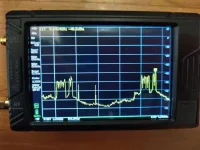
Shown below is the TinySA Ultra displaying a set of satellite transponders. Normally I set the analyzer to scan 950-2150 MHz for a scan like this. Shown below is a scan from 950-4200 MHz so the harmonics can be seen. The harmonics are almost Identical to the transponders, and they are noticeably stronger. We can deal with it since we know these harmonics exist, but having these harmonics displayed will make it a bit more complicated when searching for c band signals on the cell tower. Maybe an updated firmware version at some point in time will fix the harmonics but I doubt it. I will Live with it...

(Satellite Transponders on the left. Harmonics that are a bit stronger on the right.)
IMG_20230128_144614_hdr.webp
 
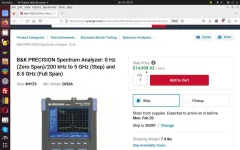
Shown below is the proper piece of equipment that is needed for portable operations. After seeing the price, I am certain that I can deal with a few harmonics. :hmmm:


Screenshot from 2023-01-29 00-24-20.webp
 
This is what Norsat has to say about lnb gain:

The gain of an LNB is amount the LNB will amplify the input signal which is expressed in dB. The input signal is very weak when it arrives at the receiving antenna and must be amplified many times before it can be transported down a coaxial cable. If the signal is not amplified the signal would be absorbed by the losses in the coaxial cable and never reaches the receiver. When selecting an LNB for a digital system it is important that the gain does not change significantly with temperature or over the received frequency range as digital systems are much more sensitive to these changes than previous analogue systems. Digital systems typically require an LNB gain to be 55 dB to 65 dB under all conditions. Gain flatness across a 500 or 800 MHz band should be better than ±5.0 dB and less than ±1.0 dB in 27 MHz segments. Variations greater than this can introduce gain distortion onto the incoming signals resulting in reduced receiver performance.

https://www.norsat.com/blogs/article/how-to-choose-the-best-lnb-for-your-satellite-system
 
Back
Top