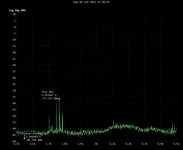
How To Look For & Find 5G Interference in C Band

LOL!

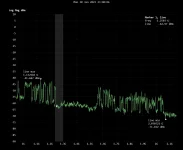
Anyway, some decent pictures of the TinySA output should be shown. The accuracy of this device in the 950-2150MHz range is impressive considering the price. 101W c band will be used as the first example. These examples are taken from the Windows computer interface. Scans are 950-2150MHz.


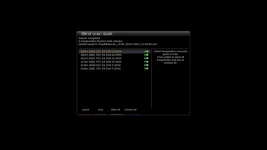
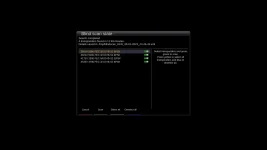
TinySa Ultra 101w-Horizontal & FTA blindscan
101w-H_LOGMAG_S11_2023-01-30_21-45-47.webp<------------------>101w-H-BS_20230130215206.webp

The TinySA Ultra clearly shows the 30,000SR transponders, and a fta blindscan is shown as a comparison. The satellite data beacon is marked in the TinySa ultra scan and of course the becon is not shown in the fta blindscan. According to SatBeams, the Horizontal beacon frequency should be 3700.5. The TinySA Ultra shows the beacon frequency to be 3699.7 (5750-2050.3). The Norsat DRO lnbs that are being used have a tolerance of +-500KHz.


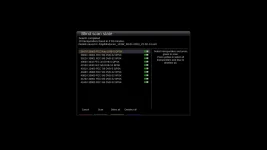
TinySa Ultra 101w-Vertical & FTA blindscan
101wv_LOGMAG_S11_2023-01-30_21-57-40.webp<------------------>101w-V-BS_20230130220231.webp

Again, the 30,000SR transponders are clearly shown. The TinySa Ultra comes impressively close with this beacon frequency of 4199.5, displaying the beacon as: 4199.399 (5750-1550.601). This sort of makes me wonder if the Vertical lnb is a bit better than the Horizontal? I have noticed the Horizontal beacon is not quite as accurate as the vertical beacon on other satellites.

Scan data can also be saved in excel format. Data for the two scans shown above are attached. Technically there are things you can do with this data, including identifying possible transponders that are not found in a blindscan. But we will not cover that in this thread.
 

Attachments

Most fta receivers cannot receive a signal lower than -60dbm.

Amazonas at 61w is noisy. my lnbs can receive from 3625MHz up to 4800MHz. Amazonas at 61w has activities above 4200MHz.


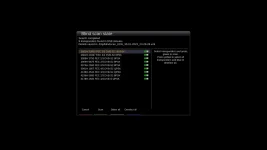
TinySa Ultra 61w-Horizontal and fta blindscan
61wH_LOGMAG_S11_2023-01-30_23-17-14.webp<------------------>61w-H-BS_20230130233337.webp

The only c band beacon SatBeams list is 4500.1H The TinySa Ultra shows 4499.7 (5750-1250.3). This frequency is marked in the scan.


TinySa Ultra 61w-Vertical and fta blindscan
61wv_LOGMAG_S11_2023-01-30_23-40-06.webp<------------------>61w-V-BS_20230130234957.webp

There is a lot of activity on this satellite. The transponders are not well defined when compared to most other satellites. Anyway, I think this proves that the TinySa Ultra is working at least fairly well on the 950-2150MHz range. Now we need to get it to show us True in-band interference from a cell tower.

The 3 GHz filter should arrive sometime this week. I will make an attempt to travel to a place where I think 5G c band frequencies are operational. Then we can see how or if the filter works. We know that the TinySa Ultra is duplicating frequencies on the cell tower when scanning above 3 GHz. So I think it could be assumed that if any 3GHz frequencies are found that cannot be tied to a duplicate of a lower frequency would be real 3GHz frequencies. We will see....
 
I asked Edision if there were any antenna feed line amplifiers anywhere in the receiver. Here is their reply:


Hello,
thank you for contacting EDISION.

The EDISION OS MIO+ receiver doesn't have any internal amplifier as it works with additional tuners (terrestrial, cable or satellite) that its chipsets are controlled from the additional software-image that the receiver has on it. Installer must provide a sufficient level signal that must overcome the minimum standard threshold, in order receiver can perform satisfactorily.

For further support about this, you must address to any professional installer with professional equipment/meter in order to help you further.


So it appears the only amplifier for the antenna feed line in a consumer type fta receiver is in the lnb. This makes sense because you want to install any line amplifier right below the antenna instead of installing the amplifier at the receiver.
 
Well that's not quite right with the internal amp's in the receiver, the satellite tuner that is installed has it's own pre-amp's and output amp to supply the receivers de-modulator chip set with the correct signal level it needs, but other then that I would agree, after the internal tuner there wouldnt be another amp.

Quote from Edision: as it works with additional tuners (terrestrial, cable or satellite)

And I would not recommend to use an external amplifier on a satellite system, all it's going to do is raise the noise floor, that is unless you can afford a professional in-line amp for 900 to 3000 MHz. (BIG $$$$)

Hey El Bandido, did that filter have any affect? Or haven't you tried it yet>
 
I am pretty familiar with the AVL6261 tuner that is in the Edision MIo receivers. I have never seen anything about amplification when working with it for the past several years. So if amplification for antenna line exists in the tuner, then I haven't seen it. The only place I see actual amplification for the antenna line is in the lnb.

There was a nice ice storm out in Texas which delayed the shipping of my 3GHz filter. I checked this afternoon and it shows "shipped". So maybe it will be here Monday or Tuesday.
 
Check out this PDF file for the tuner module, it is a generic model, but the input diagram is the same, the little pyramids on there side are the input and AGC amps inside the tuner.

View attachment DSA0096904.pdf

It has about 50 dB of variable input gain, this controlled by the RF decoder chip set.
 
Thanks for splitting the post. :bigclap:
It'll be good... til we start wandering again. :hide:

I'm enjoying reading this thread. Lots of interesting ideas and info being discussed!

BTW: If that 3G filter works... It should be renamed 'Armadillo's Delete Harmonic Disturbance' filter. Or A.D.H.D. for short. lmao
 
Check out this PDF file for the tuner module, it is a generic model, but the input diagram is the same, the little pyramids on there side are the input and AGC amps inside the tuner.

View attachment 17645

It has about 50 dB of variable input gain, this controlled by the RF decoder chip set.

What was available in 1997 might have been a little different. Look at the AVL6261: https://github.com/availink/documentation/blob/master/AVL6261/AVL6261A_product_brief.pdf
 
Well that's a de-modulator chip not the tuner module I'm talking about, the tuner is a separate item, it's what the coax from the LNB connects to, then the signal is fed into that device (AVL6261) your looking at.

And the overall design has not changed much in the last decade or two as far as the tuner module block diagram goes.
 
The 3400 to 9900 MHz high pass filter from Mouser arrived today. I installed it and immediately noticed all signals on my cell tower went away. I also did a quick check of the 5GHz router. The TinySA Ultra could pick up the 5G signals on the router when it was operating with the high pass filter installed. So the high pass filter seems to work as advertised.

I also had to drive bit today, including part of downtown Atlanta. I let the TinySA Ultra scan 3500-4500 MHz as I drove. Many cell towers were passed along the way. None of the cell towers showed any c band signals until I got within few miles of Atlanta, but even then c band cell signals were few and far between. Cellular c band signals come and go real quick as compared to other bands such as the 1900, 2500 MHz cell bands.

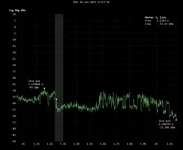
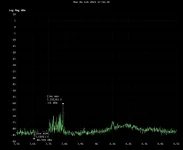
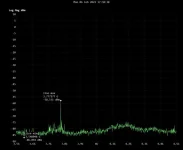
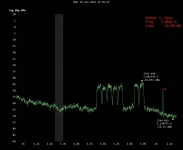
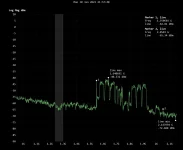
A few screenshots made with the TinySA Ultra are shown below. These screenshots were taken near Lithia Springs Ga., close to Interstate 20. A small vertical antenna was used, and no attempts were made to locate the source of these signals. But apparently, they were coming from a nearby cell tower. Personal time and traffic didn't allow for much signal hunting.

One thing I noticed about these c band cell signals is they act more like router signals. Usually when looking at a cell tower through the analyzer, the signals that are shown are consistent, or at least fairly consistent. The c band cell signals I saw to day would jump up and down in signal strength, and sometimes a small group of the signals would disappear, only to reappear a second or two later. Router signals act similar to this.

C band cell signals near Lithia Springs Ga.:
c-band1_LOGMAG_S11_2023-02-06_17-36-31.webp

tinysa4_LOGMAG_S11_2023-02-06_17-38-38.webp

tinysa4_LOGMAG_S11_2023-02-06_17-38-59.webp

I may look at these signals again when I have time and need to be in that area. I drove right by a loaded dower near downtown Atlanta that had c band cell signals a lot stronger than what is shown above. How close I was to the actual source of the signals shown above is unknown. There was a lot of clutter (buildings and such) so the tower could not be seen. It is also possible the signals shown above were from a mini cell or something similar. There just wasn't enough time to investigate. Maybe the proper time to investigate will be available another day sometime in the future.
 
....One thing I noticed about these c band cell signals is they act more like router signals. Usually when looking at a cell tower through the analyzer, the signals that are shown are consistent, or at least fairly consistent. The c band cell signals I saw to day would jump up and down in signal strength, and sometimes a small group of the signals would disappear, only to reappear a second or two later. Router signals act similar to this....

Limited number of users this early in the process. I would guess those signals become more consistent/constant in the future as more users use the spectrum. Probably be a steady buzz in a years time.

Now if you can keep that buzz no closer than Atlanta.... I'll be happy. lol
 
A Satmagazine article from May of 2020 in the link directly below does a good job of explaining 5G c band interference
http://www.satmagazine.com/story.php?number=2132459167

5G and satellite interference is pretty much a world wide problem. The main difference between North American 5G and the rest of the world 5G is frequencies. This is why you see a lot of filters that work between 3.7 and 4,2 GHz. A 3.7-4.2 GHz filter is not much of a solution for 5G interference in North America.
India Link: https://www.trackdish.com/what-is-a-c-band-5g-interference-solution/

There are also a couple of .pdf files attached to this thread that give a bit more information which may or may not be useful.

Here is a video from a person that does not seem to have a clue what 5G satellite interference is or does. it is included anyway because it is comical. This is a hobby so we should have fun, which the fellow in the video seems to do. I would say though, the idea of all of the satellite channels being moved to satellites between 91w and 107w is not correct.


Attachments

Maybe I should start my own C Band series on Youtube. :hmmm:

Take that time I was pushing the tractor with the pickup and it got away from me.. Jumped the log I had laid down and headed down the hill. That ribbon cable risked it's life to save my tractor, jumped up and wrapped around a lower hitch. Almost rolled the tractor, but finally brought it to a screeching halt. :bigthumbup:

Of course, it yanked the VBox, fta receiver, and Nintendo plumb off the entertainment center and pulled them all the way to the hole in the floor. Turned over the entertainment center and dumped the tv on the floor. Not only did nothing break... but I wound up with several extra feet of ribbon cable . :shithappens:

If I'd only thought to record it... would probably go VIRAL. :greed:

Not sure how that incident relates to 5G though. :offtopic:
 
Back
Top