TNAP-7 Image Discussion

That receiver was added last and has been ignored. It needs files. Every receiver in this build has to be added individually, then tested. The ustym4ks2ottx has not been completely tested. Give a week or two and see if we can repair it properly. I know it is missing some files....Thanks!
 
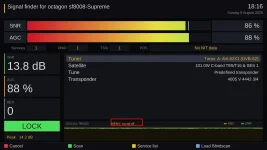
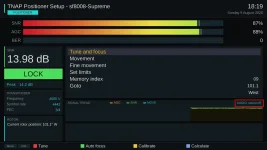
An online update or image Flash will give a Sat finder with audio option and a Positioner setup with audio option. The remote Menu button toggles the audio On or Off for Signal finder while the Audio remote button toggles the audio On or Off in Positioner setup. The Default for both of these is Audio = OFF.


Signal-finder-09_audio-highlighted.webp


positioner-setup-09_audio-highlighted.webp
 
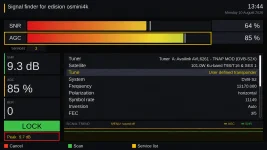
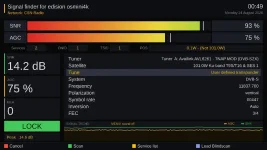
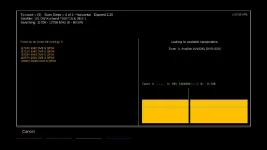
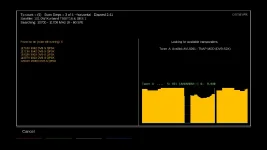
A blindscan graph has been added in today's update for Octagon SF8008 and Edision receivers. For Edision, you will need to load the T2MI-Module-TNAP-Mod driver using the driver selector plugin. This is the only driver that will work correctly with the graph. Other drivers may be used, but the graph will not display properly. The graph can be used for things like tracking motor movement and also gives an idea the scan is working.

View attachment 20047View attachment 20048
For the last 2-3 versions of tnap7, I noticed that "T2MI-Module-TNAP-Mod driver" (as recommended on post #591), shows ~2% less signal strenght compared to NoT2MI driver! That's the case for mio4k+ & mini4k.
The graph is still avilable with NoT2MI driver.
 
After updating the TNAP 7 to 20260808 image, all seemed well until I started reloading my recordings. It crashed....??

Here are the crash files:
 

Attachments

The log shows the crash happened while browsing the EPG grid (GraphMultiEPG plugin) — not literally "reloading recordings" but very close in the timeline. The skin in use (xDreamy) is missing several timer/clock icon PNGs (zapclock_add.png, zaprecclock.png, etc.

I will patch this defensively so a missing skin icon can never crash the box.
 
I suppose my words should have been Timers, and not recordings?

Thanks for looking into it
Also, this xDreamy skin is new to me, just checking it out. I would not be opposed to going back to PLI skin.

Thanks..!!
 
For the last 2-3 versions of tnap7, I noticed that "T2MI-Module-TNAP-Mod driver" (as recommended on post #591), shows ~2% less signal strenght compared to NoT2MI driver! That's the case for mio4k+ & mini4k.
The graph is still avilable with NoT2MI driver.
You can also try another version from the OpenPli forum
 
For the last 2-3 versions of tnap7, I noticed that "T2MI-Module-TNAP-Mod driver" (as recommended on post #591), shows ~2% less signal strenght compared to NoT2MI driver! That's the case for mio4k+ & mini4k.
The graph is still avilable with NoT2MI driver.
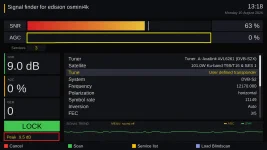
Signal Strength is just a number. Different drivers and different hardware will calculate signal strength in a different way. With the Edision driver code , you get to start with a rather large number, then divide it down until it resembles a believable Signal or db number. Drivers can also render a certain channel or frequency slightly different, but for the most part, anything you get with one driver, you should be able to get with a different driver except in edge cases of small symbol rate..etc.

AGC, sometimes refereed to as the S signal will fluctuate during scanning and dish movement. I use the AGC fluctuation on the Ku motor to have an idea when the dish has stopped moving, and I can usually tell if the dish failed to move by watching the AGC bounce. In blindscan, AGC has a tendency to bounce when a transponder is detected. The AGC can also be used to identify weak or short connections in the cabling system between the receiver and dish lnbs.

There is a distinct difference between the No-T2MI or any other driver currently available in the Driver selector plugin as compared to the T2MI-TNAP-Mod driver Because the No-T2MI driver is the only one that does NOT expose the AGC value. --Or so it seems...

As for calibrating the signal (db) or signal strength, you can spend hours trying to get one driver to precisely match the output of another driver. Get them to perfectly match for example at 9.5db, only to find there is a difference at 14,3db....Get them to match at 14.3db, only to find they do not match at 7db....etc. You can only do so much without proper environment and bench test equipment.

Here is the No-T2MI blindscan menu. Sure there is a graph, but it is flat all the way across because the AGC is not allowed to render properly:
No-T2Mi-blindscan_20260810135634.webp

Compare to the T2MI driver and you can see the AGC fluctuate:
TNAP-MOD-Blindscan_20260810134816.webp

There is a difference in the Peak signal by 2 tenths (.2) of a db. The question is: Are you watching tv or looking at a broken picture? These values are math calculations. Nothing more than that...
No-T2MI-No AGC.webp<------------------->T2MI-TNAP-Mod-AGC.webp
 
Last edited:
An online update or image Flash will give a Sat finder with audio option and a Positioner setup with audio option. The remote Menu button toggles the audio On or Off for Signal finder while the Audio remote button toggles the audio On or Off in Positioner setup. The Default for both of these is Audio = OFF.


View attachment 20148


View attachment 20147
I think they look and work great! Thanks
 
Is it possible that some transponders on the same satellite, are broadcasted with more power then others ?
e.g.: on some H tps same sr on 101w, I'm getting 15.1db & others 14-14.3db !!
same goes for V tps on the same sat & others.
 
Yes. Transponders on the same satellite may have the same or may have different power levels. And also the same Signal to noise ratio (db) on 2 or three transponders does not mean same transmitted power.

FTA receivers make an educated guess on the signal strength then compare it with what the receiver thinks the noise level is, then the receiver provides some sort of reading in db or other value to the user.
 
Date: August 14, 2026
Receiver checked: Edision OS Mio 4K
Upgradable packages shown by opkg: approximately 366


Major System Updates
glibc / libc
glibc: 2.43 → 2.44
libc6: 2.43 → 2.44
ldconfig: 2.43 → 2.44
Various glibc-gconv packages also updated.
Significance: Very high. This is the fundamental C runtime used by most Linux software.
GCC Runtime Libraries
libgcc1: 16.1.0 → 16.2.0
libstdc++6: 16.1.0 → 16.2.0
libgomp1: 16.1.0 → 16.2.0
Significance: High. These libraries support software compiled with GCC.
GNU Binutils
binutils: 2.46.1 → 2.47
libbfd: 2.46.1 → 2.47
libopcodes: 2.46.1 → 2.47
Significance: Major toolchain/platform refresh.
Python
python3-core: 3.14.6 → 3.14.7
libpython3.14: 3.14.6 → 3.14.7
Dozens of Python modules move from 3.14.6 → 3.14.7
Includes asyncio, threading, XML, JSON, SQLite, compression, ctypes, multiprocessing, logging, email, curses, etc.
Significance: Very high for Enigma2 because much of Enigma2 and its plugins are Python-based.
opkg Package Manager
opkg: 0.9.0 → 0.10.0
libopkg1: 0.9.0 → 0.10.0
Significance: High. The package-management system itself is being upgraded.
Enigma2
Enigma2 core
git23390 / 156241d0 → git23398 / dc38cd60
Significance: Eight upstream Enigma2 Git revisions are represented by the package version change.

Image flash suggested.
 
Back
Top