How To Look For & Find 5G Interference in C Band

How about a 3Ghz high pass filter to remove the harmonics? Something like this:
Code:
https://www.mouser.com/ProductDetail/Mini-Circuits/VHF-3100%2B?qs=xZ%2FP%252Ba9zWqZ5cZQdfxWmrw%3D%3D
 
How about a 3Ghz high pass filter to remove the harmonics? Something like this:
Code:
https://www.mouser.com/ProductDetail/Mini-Circuits/VHF-3100%2B?qs=xZ%2FP%252Ba9zWqZ5cZQdfxWmrw%3D%3D
I would expect this 3Ghz high pass filter would solve the harmonics or mirror issue in the TinySA. This is an excellent idea! We will see....


Harmonics, Mirrors, and false signals are mentioned in their Wiki. At least they are honest about the device.
To summarize the disadvantage of measuring in ultra mode:

Increased scan time
Fails to capture very short duration signals
Fails to capture scanning signals (e.g. from a sweeper)
Shows false signals when using with very complex or wide signals.
Higher LO leakage from RF connector

https://tinysa.org/wiki/pmwiki.php?n=TinySA4.Ultra
 
Anyone thinking about using a lnb for a signal finder or direction finding needs to consider the lnb gain. First you have to power the thing. Then you are gonna have a 50-60 db amp right next to your sensitive receiver. Coiling up 100 feet or thereabouts of some lossy rg6 might actually help in this particular situation. To me, it is much simpler and better to use a small directional antenna. You don't learn anything by doing nothing. Try it and see...

https://en.wikipedia.org/wiki/Low-noise_block_downconverter
The LNB is a combination of low-noise amplifier, frequency mixer, local oscillator and intermediate frequency (IF) amplifier. It serves as the RF front end of the satellite receiver, receiving the microwave signal from the satellite collected by the dish, amplifying it, and downconverting the block of frequencies to a lower block of intermediate frequencies (IF).

https://orbitalresearch.net/10-things-to-look-for-in-an-lnb/
Gain
Signal gain â₉€œ the extent to which an amplifier boosts the strength of the signal from the antenna â₉€œ is not usually an issue as most LNBs come with a fixed gain value of about 60 dB. However, an LNBâ₉„¢s gain is important to consider in two key circumstances: when dealing with long interfacility links (IFL) or large, high-gain antennas.
With regards to IFL, the longer the cable that connects your outdoor satellite receiver to indoor routers or transmitters, the greater the signal loss. In these cases, an LNB that delivers higher gain is necessary.
With large antennas (e.g. at teleports) too much gain can be an issue. These antennas introduce large signal power to the first stage of an LNB, which can saturate the LNB and cause signal compression. When the signal is compressed, the output power no longer increases with the input power. This creates a non-linear response â₉€œ which in turn produces signal distortion and harmonics. An LNB that can be customized for gain is critical in these circumstances.


https://www.satcomresources.com/satellite-lnb-specification-guide
Gain
The LNB Gain is the amount the incoming signal is amplified. At first glance, the higher the gain you could get would be the obvious thing to look for, however this is not the only critereon that you should be considering when it comes to LNBs. When you have a large antenna looks at a high powered group of satellites, the gain could be so high that it could overload the front end of the receiver. You could have too much gain.
Even if the receiver can handle a massive amount of signal, there can be problems within the LNB itself when a large amount of amplification is involved. This leads to the generation of artifacts, spurious signals and distortion products that are akin to the distorition that you would get from turning up the volume on your radio. This distortion will interfere with the reception of your signals.
So unless you have specific reasons for an ultra-high gain LNB, then look for a gain of around 50 - 60 dB.


There is a group of idiots or uninformed that think more lnb gain is great. Just use a 70db gain lnb and a smaller dish. Everything will be OK

https://www.megasat.tv/en/produkt/high-gain-single-lnb/
LNBs high-gain
The ideal solution for difficult to receive satellites and small satellite dish. high-gainLNBs satellites offer a high signal amplification of 70 dB. This ensures good signal stability even for a small Camping dishone with a diameter of just 40 cm.
The low noise figure of only 0.1 dB ensures the best picture and sound quality.
The Single LNB is suitable for reception from a satellite and for connection to a receiver.

The low noise figure of only 0.1 dB....Lol. How many times do we hear that lie?
The same rules of an antenna apply: You cannot increase antenna performance by using amplifiers that increase gain. You can amplify a signal that is already there, but you cannot create more signal with a signal amplifier.
 
I would expect this 3Ghz high pass filter would solve the harmonics or mirror issue in the TinySA. This is an excellent idea! We will see....
https://tinysa.org/wiki/pmwiki.php?n=TinySA4.Ultra

I should have added: I just guessed on the sma type. Get a filter with the connectors to match the TinySA, (Or adapters) Too lazy to look up the specs or do a bunch of searching last night.

Possibly something cheaper/better available if you search around. :bigthumbup:
 
The filter you picked out looks correct. It will depend though on which way the filter needs to be inserted, or if it matters which way the filter is inserted. Microwave parts are high when compared to antenna parts that are lower in frequency. What you have picked out also has a decent price when considering its operating frequency.
 
How about a 3Ghz high pass filter to remove the harmonics? Something like this:
Code:
https://www.mouser.com/ProductDetail/Mini-Circuits/VHF-3100%2B?qs=xZ%2FP%252Ba9zWqZ5cZQdfxWmrw%3D%3D

You need to filter the 5G signals and the harmonics before they get to the pre-amps inside the LNB, using one after the signals are down converted will do nothing, only an LNB manufactured with a band pass, or low band reject filter built inside will do the job. (or as best as it can if the 5G signal is too strong)
 
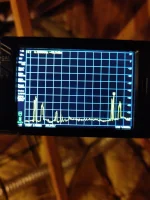
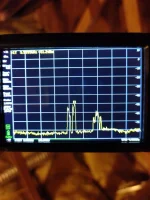
To be clear, The TinySA is displaying frequencies around 1.8 -2GHz twice, Once on the correct frequency, and again on the second harmonic. When a cell tower is scanned for 3-4 GHz frequencies ONLY, then the second harmonic for the 1.8-2GHz are shown as 3-4GHz frequencies that do not exist! So you get the fake 3-4GHz frequencies on the TinySA Ultra when you scan 1.5-4.2 GHz, OR when you scan 3.5-4.2GHz. This is nothing more than a defect in equipment, and installing a 3Ghz high pass filter might remove the fake c band signals that are shown when scanning 3.5-4.2GHz.

The 3Ghz high pass filter to remove the harmonics would be used when using the TinySa Ultra to look for c band signals on the cell tower, or other places such as Home Internet routers. The 3Ghz high pass filter Would Not be used when the TinySa Ultra is connected to the lnb because the lnb signals are down-convereted to 950-2150 MHz. The 3Ghz high pass filter Would Not be used or installed inline with the lnb.
 
For more clarity, we will show two scans. These scans were done on an antenna aimed directly at the cell tower.

Scan from 1.7-4.2GHz
IMG_20230130_120734_hdr.webp


Scan from 3.5-4.2GHz
IMG_20230130_120844_hdr.webp


The signals on the right(c band) mirror the signals on the left(cell signals) in the first scan.

The second scan shows the same c band frequencies as the first scan, but the scan range was set to 3.5-4.2 GHz.

So we "Assume" that inserting a 3Ghz high pass filter to block anything below 3GHz on the TinySa Ultra will make it read correctly. Will have to do two things to check this: (1) Buy the 3Ghz high pass filter, and (2) Find a cell tower that is actually transmitting in the 3.5-3.9GHz band to test it on. Buying the filter can be done. Finding a tower that is actually transmitting somewhere in the 3.6-3.9GHz range can be done.

Everything looks OK when the TinySA Ultra is connected to the lnb on the satellite dish. The transponders display correctly, and the data stations such as satellite beacons display correctly. So we could assume that the TinySA Ultra -would also show in-band interference if such interference were to exist. There does not appear to be any in-band interference at my location to date, but that could change...
 
Never used a "TinySA Ultra" but looked at the manufactures web page, it says that it goes up to 950 MHz, how are you looking at signals around 1.5 to 4,2 GHz ???

Just wondering?

never mind I found whats going on from the web site.

It maybe that the spurs your looking at may be generated internally when you switch to ultra mode.

https://tinysa.org/wiki/pmwiki.php?n=TinySA4.Ultra
 
Last edited:
I think it is very Obvious as to what the TinySA Ultra is displaying by looking at the First picture in post#91 above. The terms Second Harmonic or Mirror would be a good description.


One VHF-3100+ filter has been ordered. According to the attached .pdf document, insertion loss should be less than 1 db.

Note To Self:
If this filter doesn't work, then send the bill for it to the 'Dillo dude.
If this filter does work, then claim ownership of the idea.
 

Attachments

Hard to see those photos, the indications are fuzzy, but I see what your looking at, how many dB down are the interference signals as I cant read the scales too good.

And you said you used an antenna looking at the towers, can you mount that antenna at the dishes focal point?
 
It is hard to get a good. clear picture of the TinySA display. Almost next to impossible it seems. But I think the picture is clear enough to see the signals on the right are duplicates of the signals on the left.

I don't think there are any real 3GHz interfering signals as they did not pass a process of elimination test. If those 3GHz signals are real, then they should be on the satellite dish, which they are not. The 3GHz signals look like an exact copy of the cell tower signals around 1.9 GHz. The 3GHz signals are shown to be stronger by 5-8 db as compared to the 1.9GHz signals. If the 3GHz signals were real, then it would seem they should be about equal in strength or less in strength as compared to the 1.9GHz signals. The cell antenna is on a tower about 40 feet up. If I want to look at the signal on the dish, then I connect the TinySa Ultra to the dish lnb.
 
Well lets see if the filter helps out.

Back in my cable TV days we had a test LNBF for the big dish's, it had a test port on it that taped into the final output of the first amps, just before the mixer, this is where we would connect the spectrum analyzer,(and other stuff) it was great for final peaking of the dish.

But back them we didn't have problems with 5G, heck there wasn't even a cell phone system yet, all we had to contend with were the Russian spook satellites messing things up.

I wish I had access to the equipment I had back then, I would like to see if something like this is around my area.
 
You need to filter the 5G signals and the harmonics before they get to the pre-amps inside the LNB, using one after the signals are down converted will do nothing, only an LNB manufactured with a band pass, or low band reject filter built inside will do the job. (or as best as it can if the 5G signal is too strong)

Terryi, this was referring to using a TinySA Ultra with an antenna to TEST for 5G interference.

The topic kinda expanded as time went on, so I see where it could be confusing. Probably Elbandido's fault.... 'cause I never ramble off topic. :rofl:

Maybe some of this thread should be moved to a new 'TinySA' thread?

It's all good!
 
I think it is very Obvious as to what the TinySA Ultra is displaying by looking at the First picture in post#91 above. The terms Second Harmonic or Mirror would be a good description.


One VHF-3100+ filter has been ordered. According to the attached .pdf document, insertion loss should be less than 1 db.

Note To Self:
If this filter doesn't work, then send the bill for it to the 'Dillo dude.
If this filter does work, then claim ownership of the idea.

Just charge it to 'The Ground' and let the rain settle it. lol

Even without 5G interference, it will prove whether the 3Ghz filter removes the harmonics. If the filter works: Be good to have for future use, Never know when harmonics from other freqs below 3Ghz might show up.

Besides... I prefer spending someone else's money rather than mine. :laugh: :thanx:
 
Yah I agree, part of this is my fault, I tend to ramble on in my old age after too much coffee.

A new thread may be needed as I'm now very interested in this 5G stuff.
 
Terryi, this was referring to using a TinySA Ultra with an antenna to TEST for 5G interference.

The topic kinda expanded as time went on, so I see where it could be confusing. Probably Elbandido's fault.... 'cause I never ramble off topic. :rofl:

Maybe some of this thread should be moved to a new 'TinySA' thread?

It's all good!
Naaaa my fault, they still blame me for the Titanic.
 
Getting WAY off topic now: Watched a show the other day. Claimed there was a fire in one of the coal bins before the Titanic began its cruise. Fire was still burning during cruise. Old pictures show a dark spot on the hull. Happens to be right where the iceberg later struck. They speculated the fire weakened the bulkheads. The Inquiry pretty much covered it up. Who knows?

So maybe they'll quit blaming Terryl now.... unless he started the coal fire. :point:
 
Back
Top